
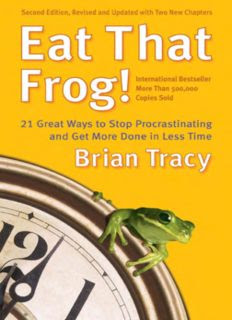
EAT THAT FROG – 21 WAYS TO STOP PROCRASTINATING AND GET MORE DONE IN LESS TIME BY BRIAN TRACY
Author Brian Tracy calls this “eating your frog,” quoting Mark Twain. Twain famously said that if the first thing you do in the morning is eat a live frog, you can go through the rest of the day knowing the worst is behind you. Your frog is your worst task, and you should do it first thing in the morning.
Eat that Frog is a book written by Brian Tracy and it is a compilation of ideas and techniques from many influencers in the time management and personal productivity industry. The book covers many different ways of overcoming procrastination and it makes it very accessible for people to apply the techniques. It’s written in very simple terms – don’t expect any jargon or scientific studies to back up the methods. The advice given all comes from the real life experience of the author, and the focus of the book lies in actionable exercises and tips you implement right away
There are 21 chapters and each chapter introduces a different idea, tip, or technique that will help you overcome procrastination and get more things done
The Book in Three Sentences
- Your ‘frog’ is your biggest, most important task
- If you have two frogs, eat the ‘ugliest’ one first
- If you have to eat a frog, don’t procrastinate on it
The Five Big Ideas
- “The key to reaching high levels of performance and productivity is to develop the lifelong habit of tackling your major task first thing each morning.”
- “Think about your goals and review them daily. Every morning when you begin, take action on the most important task you can accomplish to achieve your most important goal at the moment.”
- “Think on paper.”
- “Always work from a list.”
- “Your ability to choose between the important and the unimportant is the key determinant of your success in life and work.”
A brief on the various chapters in the Book
1. Set the Table Think on paper.
2. Plan Each Day in Advance. Always work from a list
3. Apply the 80/20 Rule to Everything. Before you begin work, always ask yourself, ‘Is this task in the top 20 percent of my activities or in the bottom 80 percent?’
4. Consider the Consequences. Long-term thinking improves short-term decision making.
5. Apply Creative Procrastination. The difference between high performers and low performers is largely determined by what they choose to procrastinate on.
6. Use the ABCDE Method. You start with a list of everything you have to do for the coming day. Think on paper. You then place an A, B, C, D, or E next to each item on your list before you begin the first task. A to do first then B, C is nice to do, D can be delegated, E can be eliminated.
7. Focus On Key Result Areas. What one skill, if I developed and did it in an excellent fashion, would have the greatest positive impact on my career?
8. Apply The Law Of Three. It is the quality of time at work that counts and the quantity of time at home that matters.
9. Prepare Thoroughly Before You Begin. Brian’s personal rule is “Get it 80 percent right and then correct it later.
10. Take It One Step at a Time. Get your mind off the huge task in front of you and focus on a single action that you can take.
11. Upgrade Your Key Skills. Continuous learning is the minimum requirement for success in any field.
12. Leverage Your Special Talents. Continuously check your special talents and work on them to grow.
13. Identify Your Key Constraints. Successful people always begin the analysis of constraints by asking the question, “What is it in me that is holding me back?
14. Apply Pressure On Yourself . Work as though you have only one day to get your most important jobs done.
15. Maximize Your Personal Powers. Whenever you feel overtired and overwhelmed with too much to do and too little time, stop yourself and just say, ‘All I can do is all I can do.
16. Motivate Yourself Into Action. Optimism is the most important quality you can develop for personal and professional success and happiness.
17. Stop Technological Time Drain. For you to stay calm, clearheaded, and capable of performing at your best, you need to detach on a regular basis from the technology and communication devices that can overwhelm you if you are not careful.
18. Slice And Dice The Task. Cut a big task down to size using the “salami slice” method of getting work done.
19. Create Large Chunks Of Time. Make work appointments with yourself and then discipline yourself to keep them. Set aside thirty-, sixty- and ninety-minute time segments that you use to work on and complete important task.
20. Develop A Sense Of Urgency. When you work on your most important tasks at a high and continuous level of activity, you can actually enter into an amazing mental state called ‘flow.
21. Single-Handle Every Task. Single handling requires that once you begin, you keep working at the task without diversion or distraction until the job is 100 percent complete.

 Best Books to Read and Listen