
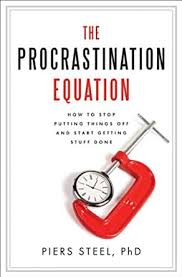
THE PROCRASTINATION EQUATION : HOW TO STOP PUTTING THINGS OFF AND START GETTING STUFF DONE
BY PIERS STEEL
Piers Steel is a recognized expert on topics like motivation and procrastination and in his book “The procrastination equation” he gives an equation you can use to analyze exactly why you procrastinate.
The Procrastination Equation
- Different people procrastinate for different reasons, corresponding to the different variables in the Procrastination Equation: Motivation = (Expectancy x Value) / (Impulsiveness x Delay). Procrastination results from lowering Motivation too much.
- Expectancy = how likely you think you are to reach your goal
- Value = the value you place on the goal
- Impulsiveness = how influenced you are by short-term vs. long-term gratifications
- Delay = how far into the future the goal is
- Understanding why you procrastinate is a major first step towards reducing procrastination.
- The book has an assessment tool you can use to help you identify why you procrastinate.
-
Reasons for procrastination
- Low Expectancy (= lack of optimism): Some people procrastinate because they lack the optimism that they’ll be able to achieve their goals, so why try too hard?
- High Expectancy (= overconfidence): This is the opposite of lack of optimism. People with this issue delay because “I can always do it later”.
- Low Value (= lack of enjoyment): Many people procrastinate because the goal isn’t high enough value to make them want to do the unenjoyable steps that lead up to it.
- Tiredness (#1 reason for procrastination): This is really just a special case of the work being unenjoyable – people who are tired just want to relax and/or rest, not work.
- Impulsiveness: People who are impulsive find it hard to focus on long-term goals and to keep from getting distracted or tempted along the way.
-
Suggestions Goals should be:
-
- Attainable but challenging (challenging is the more important)
- Meaningful (tied to larger goals / values)
- Short-term
- [This reduces the Delay part of the Procrastination Equation.]
- Day goals are good
- 5-10 min. goals if main challenge is getting started
- Specific
- Break down large goals into sub-goals
- Goals can be inputs (time worked) or outputs (words written) or both (e.g., whichever comes first)
- Good habit formation makes work routine, subconscious, and effortless
- Have a predictable environment, especially time and place
- State an explicit intention to act, even just “if X happens then I’ll do Y” (really works!)
- Habits are hard to start, and only start working after a bunch of repetitions, so keep that in mind when coming up with excuses for the first few times
- Might be worth extra money to pay someone (coach, personal trainer, etc.) to help get it up and running
-
-
Set good goals
“The Procrastination Equation will teach you how to bust the excuses that are preventing you from doing your best work and living your best life….So don’t put it off any longer.

 Best Books to Read and Listen