
Summary
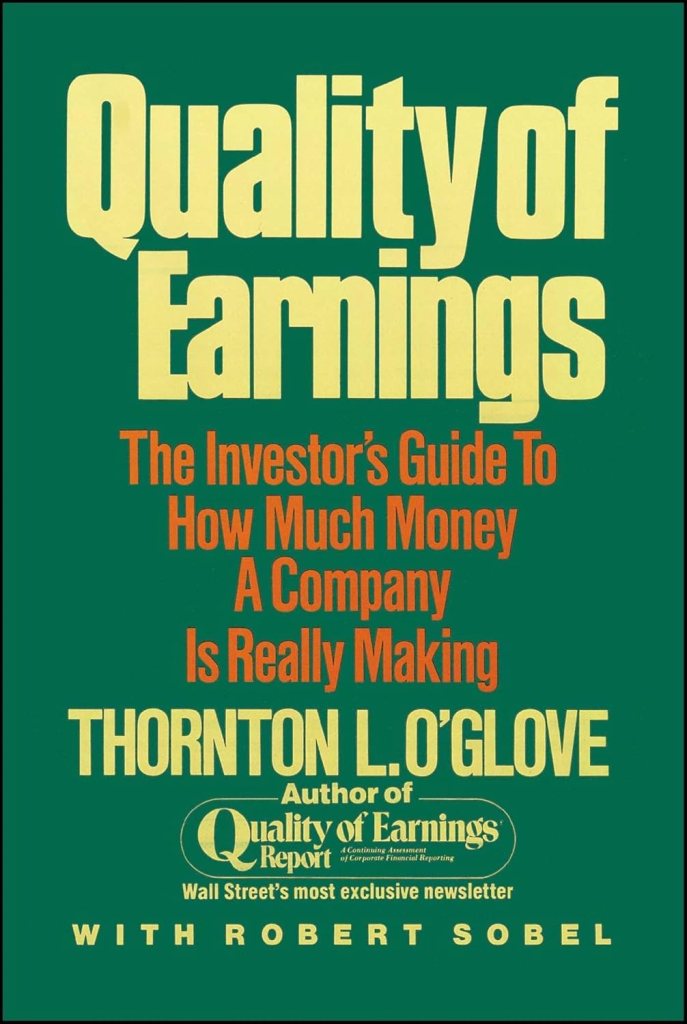
This is an investor’s guide titled “Quality of Earnings” by Thornton L. O’Glove, designed to help readers discern how much money a company is truly making beyond what superficial financial statements might suggest. The book emphasizes that investors should not blindly trust analysts or auditors, advocating for a deeper, more informed analysis of financial data. Key themes explored include understanding nonoperating and nonrecurring income, analyzing declining and increasing expenses, and comparing shareholder reporting versus tax reporting to uncover potential manipulations. Ultimately, the book aims to equip investors with the tools to identify “accounting fluff and gimmickry” that can overstate earnings and to make more robust investment decisions.
The central theme of the book is to provide investors with a guide to understanding how much money a company is really making, moving beyond superficial financial statements. O’Glove emphasizes that investors need an informed analysis of readily available materials to make knowledgeable buy and sell decisions. He observed that many companies’ earnings reports can be “partially illusory,” making a deep understanding of “quality of earnings” crucial for meaningful financial analysis.
The book is praised by various financial and academic professionals:
- Professor David Hawkins of Harvard Graduate School of Business Administration notes that O’Glove shows how to profit from earnings quality signals.
- Frank Fabozzi, Managing Editor of the Journal of Portfolio Management, recommends it for learning to analyze financial statements and identify what you don’t know.
- Charles Ellis of Greenwich Associates describes O’Glove as a “professional, an insightful thinker and a fine writer,” making the book essential for every investment professional.
- Martin E. Zweig of The Zweig Forecast states that O’Glove “cut through accounting fluff and gimmickry” and helps identify stocks to avoid due to overstated earnings.
- Monte J. Gordon, Director of Research at The Dreyfus Corporation, calls “Quality of Earnings” a “refreshing and welcomed expression” of the need to understand company fundamentals, asserting that intensive research can uncover “unrecognized fundamental impediments and dangers”.
Thornton L. O’Glove’s background as a finance major, stockbroker, and author of the “Quality of Earnings® Report” newsletter provides the foundation for the book’s insights. He observed that markets are often imperfect and do not always reflect all that is known about a security. He became disillusioned with the superficial analysis prevalent on Wall Street, where many professionals concentrated on current labor rather than thorough financial analysis, leading him to return to research and evaluation. He expresses gratitude to figures like Leonard Spacek and Abraham J. Briloff, whom he dedicates the book to as “The Consciences of Accountancy,” for their contributions to improving financial accounting reforms and for influencing his understanding of accounting practices that can distort earnings.
The book covers various critical aspects of financial analysis, aiming to provide a comprehensive guide for investors. Key chapters and topics include:
- Don’t Trust Your Analyst
- And Don’t Trust Your Auditor
- Person to Person: A Shareholder Letter
- Differential Disclosure
- Nonoperating and/or Nonrecurring Income
- Declining and Increasing Expenses
- Shareholder Reporting versus Tax Reporting
- Two Key Ratios: Accounts Receivable and Inventories
- Debt and Cash Flow Analysis
- Dividends: The Tender Trap
- The Importance of Understanding Accounting Changes
- Coming Clean After the Big Bath and/or Restructuring
Ultimately, the book’s message is that individual investors, through diligent analysis and hard work, can avoid pitfalls and maximize their chances of making profits, rather than relying on “magic formulas”. It encourages investors to dig deeper into financial statements and understand the underlying realities of a company’s financial health.

 Best Books to Read and Listen