
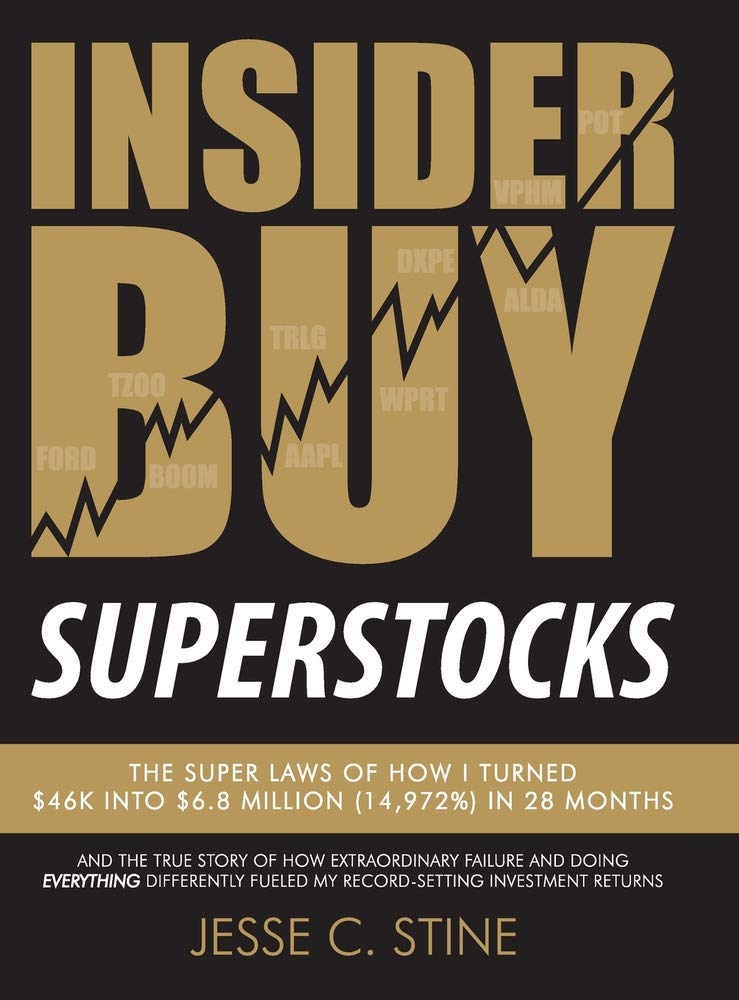
Here’s a blog post drawing on the insights from “Insider Buy Superstocks” by Jesse C. Stine:
Unlocking Market Fortunes: The Unconventional Path to Superstock Success
Have you ever wondered if there’s a different way to approach the stock market, one that deviates from the conventional wisdom and potentially leads to extraordinary returns? Jesse C. Stine, author of “Insider Buy Superstocks,” offers a compelling case for doing “everything differently” to achieve “massive returns”. Stine’s own experience saw his self-managed portfolio appreciate a staggering 14,972% from $45,721 to $6,845,342 between October 2003 and January 2006, while the S&P 500 returned only 25% during the same period. This book, written as his life’s work, shares the actionable knowledge he accumulated from years of market study and “hand-to-hand combat”.
It’s crucial to understand that the information presented is designed for educational purposes only and does not represent a recommendation to buy or sell stocks. The methods discussed are not guaranteed to be profitable and can result in losses, as past results are not necessarily indicative of future results. Stine openly acknowledges enduring immense account drawdowns, sometimes over 60%, but emphasizes that overcoming these setbacks is part of the journey to becoming a successful trader.
The Elusive Superstock: What to Look For
At the heart of Stine’s philosophy are “Superstocks”—the market’s biggest winners. These are not your average stocks; they are unique situations that often defy traditional limitations and attract the market’s “very best traders”. Stine defines a Superstock as an undervalued stock with the absolute best fundamentals aligned with the very best technicals, trading at a distressed price. His sole purpose is to discover the one or two future winners globally with ultimate risk/reward characteristics, including undervaluation, rapid growth, a solid technical base, an inspiring theme, and an “It Factor,” ideally supported by recent insider buying.
Stine breaks down the characteristics of a Superstock into key “Super Laws”:
Top 5 Technical Must-Haves at Breakout:
- Strong Base Breakout: A stock trading sideways in a narrow range for an extended period, weeding out short-term traders. The longer the base, the larger the ultimate advance.
- Breakout Above 30-Week Moving Average: 90% of history’s biggest gainers broke above or stayed above their 30-week moving average during their initial high-volume breakout.
- Volume Expansion: An “extreme volume expansion” (500% to 5,000%) at the initial breakout, signaling substantial accumulation by institutional investors.
- High Angle of Attack: The stock advances at roughly a 45-degree angle from its base, indicating significant percentage moves.
- Under $15: The “sweet spot” for maximum percentage moves is typically the $4-$10 area, as lower-priced stocks have greater potential for percentage gains. Stocks also become “marginable” around $4-$5, attracting institutional buying.
Key Fundamental Super Laws:
- Earnings Winner: Consistently reported quarterly revenue and EPS, with a significant jump in the most recent quarter.
- Sustainable Earnings: The new level of earnings must be sustainable, often due to a new product, cost-cutting, new customers, or industry catalysts. Management guidance or conference call transcripts can provide clues.
- Annualized PE of 10 or Less (Undervalued): Entering a growth stock at such a low valuation limits downside risk and builds confidence.
- Open Market Insider Buying: Purchases by multiple C-level executives or directors using their own money, especially during a base-building period or just after breakout, signal a major fundamental catalyst is on the horizon. This is distinct from token buys, stock option buys, or post-disaster buys.
- Low Float and Low Market Cap: Low float (under 10 million shares) stocks are easier for momentum traders to manipulate higher. Most big gainers start with market caps under $100 million.
- The “It Factor” / Super Theme: A unique, often new, theme (product, industry, technology) that stirs imagination and attracts investor attention, such as “local search” or “explosive metalworking”.
The Contrarian Mindset: Going Against the Herd
One of Stine’s most emphatic points is the necessity of going directly against popular opinion. The market, in his view, is far more manipulated than most imagine, with “smart money” actively controlling the news to their advantage.
- Mass Media as a “Potent Drug”: Stine contends that “news” is a powerful “money-making deterrent”. If you can’t find a single article supporting your investment premise, it’s likely a winner. Conversely, if your idea appears in the mainstream press, it’s probably time to sell. He argues that journalists write for a living, not to make money, and are often wrong at critical market turning points.
- “Drudge Indicator”: Stine uses indicators like the “Drudge Market Indicator” to gauge social mood, noting that when financial news goes mainstream, it’s often near a market inflection point (top or bottom).
- Focus on Charts, Not Stories: Stine believes that charts convey “absolutely EVERYTHING” and paint a clearer picture “months or even years” before the fundamental story becomes evident to the average investor. He advises to never buy a company’s story, but rather buy prices.
Mastering the Psychology of Trading
Beyond technicals and fundamentals, Stine stresses that proper mindset is “absolutely essential” to investing success. He states that “human emotion is reflected in the form of market prices,” making mastery of one’s emotions crucial.
- Cultivate Individual Thinking: Stine advocates for trading in “complete isolation” to avoid the “corrupting effects of groupthink”. The “best traders” are independent loners willing to “discount other’s opinions”.
- Confidence is Key, Overconfidence is Dangerous: While supreme confidence is necessary, overconfidence, especially after large profits, can lead to “shoddy decisions” and significant losses.
- Embrace Losses: Losses are viewed as a “part of the cost of trading education”. Stine encourages learning from failures rather than punishing oneself.
- Patience and “Relaxed Faith”: Once a position is established, “it is then time to sit back, relax, and become a patient Zen-master trader”. Watching every tick or other traders’ actions is counterproductive. The market works on its own timeframe, often rewarding those who wait.
- Discipline: Self-discipline is “vastly more important than intelligence” in achieving investing success. This includes a disciplined approach to stock selection, entry/exit points, and reaction to volatility.
- No Revenge Trading: After a loss, avoid the urge to take a larger-than-normal position in a questionable stock to recoup money; these “almost ALWAYS end in failure”.
The Art of Buying and Selling
Low-Risk Entries:
- Buy the “Magic Line”: This is often near the 10-week simple moving average, where smart money institutions accumulate shares. “Great news always comes out about your stock right around the time that it meets its magic line”.
- “Buy Light and Tight” (BLT): Entering when a Superstock moves within a very tight band on relatively light weekly volume, often after a decline, as this indicates a resting period before a new run.
- Buy the “Gap” Test: After a “breakaway gap” from a substantial earnings surprise, the stock may re-test this gap as a zone of “fundamental support”.
- Wait 2-3 Weeks After Monster Earnings: The initial euphoria wears off, and the stock often settles down, offering a better low-risk entry.
- Buy the Lower Trendline: In an uptrend, positioning at the lower trendline offers a low-risk entry, as breakout traders buy the higher trendline.
The Super Laws of Selling (Crucial for Success):
- Selling is “ABSOLUTELY ESSENTIAL”: Stine argues that where you sell is “1,000 times more important than where you buy”.
- Sell at Sentiment Extremes: The best times to exit are when “everything looks great,” when “everybody is talking about your stock,” or when it’s being “prominently featured”.
- Sell Time and Large Deviation from Magic Line: If a stock trades 60% or more above its “magic line” after the first six weeks of its breakout, it may be time to take profits. Strongest stocks often peak 7-10 weeks after surging off their magic lines.
- Sell After a 9 to 15 Month Advance: Many of the biggest winners collapse within this broad window after their initial breakout.
- Sell a Parabolic Run: These “buying climaxes” mark the end of a run and can collapse 30% or more within days.
- Sell Large Price Ranges: An “extreme price range on a weekly bar coinciding with large volume well into a stock’s advance” often indicates “longer-term buying capitulation”.
- Sell Secondary Offerings/Private Placements: Such announcements signal that management believes the stock is near a top; “run for the hills as fast as you possibly can”.
- Sell on Headlines/Message Board Euphoria: If your stock’s story becomes “well-guarded secret” is no longer secret but now featured in national media or if its message board shows “utter pandemonium,” it’s time to sell.
Do Everything Differently
Stine emphasizes that to achieve “massive success,” you must do things “entirely different than just about everybody else”. This includes:
- Focus on Weekly and Monthly Charts: These are the “gold standard” for investment decisions, as they are “much more reliable” than daily charts.
- Buy Weekly Boredom: Accumulate positions quietly when volume and volatility are at a minimum and “nobody is talking about your stock”.
- Focus Exclusively on Small Capitalization Stocks: These offer the greatest percentage moves, unlike large caps which are heavily covered and have limited information edge.
- Wait Until Everything Lines Up: Don’t invest just because you “like” a company. Wait until “most of the technical Super Laws line up, most of the fundamental Super Laws line up, and the market conditions are favorable”.
- Invest on an Island: Eliminate all “noise” from CNBC, social media, and friends’ opinions to make your own unbiased decisions.
- Buy Individual Stocks, Not Mainstream ETFs or Mutual Funds: Information arbitrage, which is critical for outsized returns, exists in individual stocks, not broad funds.
- Stop Investing in “What You Know”: Peter Lynch’s advice is a “groupthink” trap. Instead, invest in “future themes that nobody yet knows about”.
- Become a Sentiment Stud: Learn to buy “boredom and fear” and sell “euphoria”.
- Sell as Your Stock Rises: Don’t wait for stop-losses to be triggered on the way down; take profits as the stock reaches euphoric technical extremes.
- Divorce Yourself from Mass Media: The media actively attempts to make you do the “exact opposite of what you should be doing”.
Stine’s journey, fraught with both “extraordinary defeats” and “victories”, highlights that “extraordinary drawdowns could almost be considered a prerequisite for massive trading success”. However, he hopes readers can learn from his “failures” without experiencing the same level of risk. Ultimately, the goal is to develop a “Millionaire Mindset” that inspires action to achieve financial dreams by understanding and mastering the fundamental rules of the market, which he argues is a “rigged game”.
To truly succeed, he implores, “make investing your passion” and engage in continuous “self-education”.

 Best Books to Read and Listen