
Unlocking Market Secrets: Why “Capital Returns” is a Must-Read for Every Investor
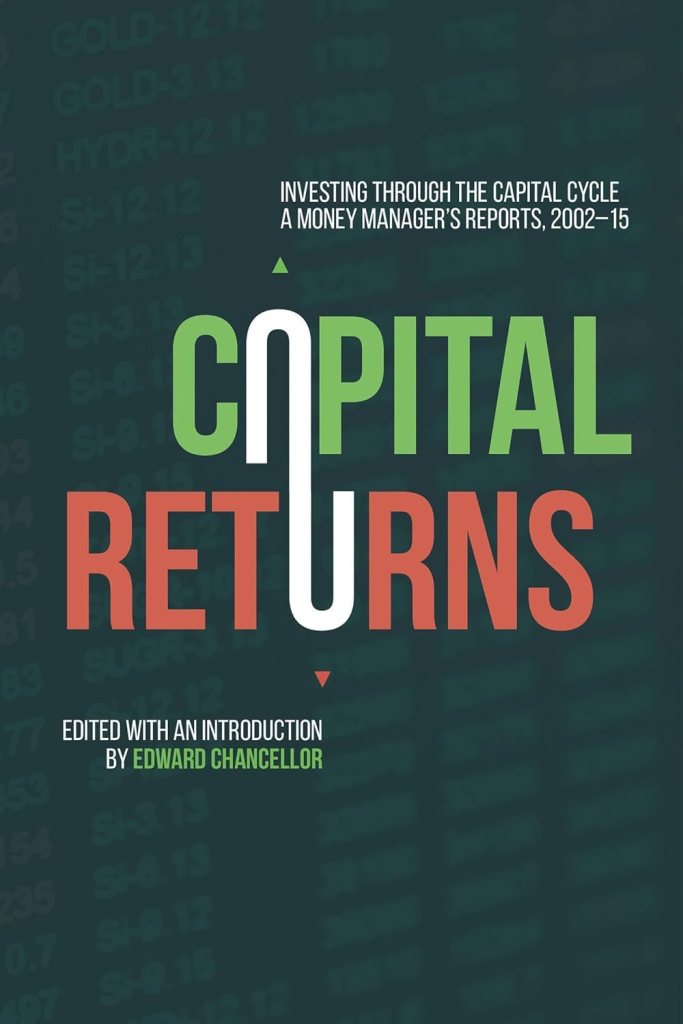
Have you ever wondered why certain industries experience spectacular booms only to crash and burn, leaving investors with significant losses? Or why some “value” stocks remain cheap for years, while “growth” stocks continue to defy high valuations? The answers, as brilliantly explored in Edward Chancellor’s edited collection “Capital Returns: Investing Through the Capital Cycle: A Money Manager’s Reports 2002–15”, lie in understanding the capital cycle. This isn’t just another investment book; it’s a profound deep dive into the very mechanics of capitalism and a vital guide for anyone seeking to navigate the unpredictable tides of the market.
Marathon Asset Management, whose investment reports from 2002–15 form the core of this book, has refined an investment philosophy centered on two simple yet powerful ideas: the ebb and flow of capital in response to returns, and the crucial role of management skill in allocating that capital. Far from being a dry academic text, “Capital Returns” vividly illustrates these concepts through real-world examples, offering explanations, details, and insights that go far beyond mere summary, making it an indispensable read.
The Core Philosophy: Understanding the Capital Cycle
At its heart, the capital cycle describes how changes in the amount of capital employed within an industry directly impact future returns. It’s a dynamic, cyclical process driven by Schumpeter’s notion of “creative destruction”. Here’s how it generally unfolds:
- High Returns Attract Capital: When a business or industry is highly profitable and generates returns above its cost of capital, it attracts significant investment. This can lead to overconfidence among managers, who may mistake benign industry conditions for their own exceptional skill. Investment bankers, driven by fees, eagerly facilitate new capital raises through secondary share offerings and IPOs.
- Increased Capacity and Falling Returns: This inflow of capital leads to new investment and increased capacity in the sector. Over time, this expanded supply begins to put downward pressure on prices and eventually pushes down returns. Demand forecasts, often overly optimistic during booms, are proven wrong.
- Capital Exits and Capacity Reduction: As profits collapse, industries face oversupply. Management teams are often changed, capital expenditure is slashed, and consolidation begins. Weaker firms may exit the market through bankruptcy or acquisition.
- Profitability Recovers: The reduction in investment and contraction in industry supply eventually paves the way for a recovery of profits. For a discerning investor, this is the moment when a beaten-down stock or industry becomes potentially interesting.
The “cobweb effect” highlights the inherent instability created by the lag between investment decisions and their impact on supply. Supply changes are often lumpy and prone to overshooting, leading to periods of massive excess capacity.
The “Asset-Growth Anomaly” and the Power of Mean Reversion
While Marathon’s approach might seem like “common sense” to many outside the financial industry, academic research has increasingly validated its insights. A key finding, termed the “asset-growth anomaly,” observes an inverse relationship between capital expenditure and investment returns. Firms with the lowest asset growth have historically outperformed those with the highest asset growth. Corporate events associated with asset expansion (M&A, equity issuance, new loans) tend to be followed by low returns, while events associated with asset contraction (spin-offs, buybacks, debt prepayments) are followed by positive excess returns. This negative impact can persist for up to five years.
This phenomenon can be viewed through the lens of mean reversion. As Benjamin Graham and David Dodd observed in “Security Analysis,” businesses with high returns attract competition, which naturally drives down future profitability. Conversely, businesses with abnormally low earnings benefit from a lack of new competition and the withdrawal of old competitors, eventually leading to a recovery in profits. Investment itself drives this mean reversion for both individual companies and entire markets. Periods of high aggregate corporate investment often precede declines in profitability and economic recessions.
Interestingly, the book points out a conundrum in the US stock market post-2010, where stocks looked expensive due to above-average profits, yet corporate investment was lackluster. This lack of a key driver of mean reversion allowed profits to remain elevated for longer than expected. China, by contrast, presented the opposite picture: often cheap stock prices but elevated investment and asset growth, leading to poor corporate profitability.
Behavioral Biases and Skewed Incentives: Why Markets Get It Wrong
If the capital cycle is so fundamental, why do so many investors and managers miss its signals? The sources attribute this market inefficiency to a combination of conventional findings from behavioral finance and agency-related problems.
- Overconfidence: Both investors and corporate managers are often infatuated with asset growth, mistaking growth for value. They are prone to overconfidence in forecasting, especially future demand, which is notoriously difficult to predict.
- Competition Neglect & Base-Rate Neglect: Overinvestment is rarely a solitary act; it happens when multiple players in an industry simultaneously increase capacity without fully considering the impact of increasing aggregate supply on future returns. This is linked to “base-rate neglect,” where investors focus on current (and projected) profitability while ignoring crucial changes in the industry’s asset base.
- The “Inside View”: Decision-makers often adopt an “inside view,” focusing on specific circumstances and their own experiences, rather than considering the problem as an instance in a broader reference class or looking for historical parallels. Industry specialists are particularly prone to this, failing to see the broader industry risks while focusing on granular details. This leads to linear forecasts in a cyclical world.
- Extrapolation & Recency Bias: Our brains are hard-wired to extrapolate current trends and are overly influenced by immediate experiences (“recency bias”), leading to a propensity for linear thinking even in cyclical environments. This makes investors prone to “excessive extrapolation of multiyear growth rates,” leading to disappointment when growth inevitably mean-reverts faster than expected.
- Skewed Incentives: Executive compensation schemes, often tied to short-term performance metrics like earnings per share (EPS) growth or market capitalization, incentivize managers to prioritize growth and asset expansion, even at the expense of long-term returns. Investment bankers, compensated by fee generation, are also incentivized to “lubricate the wheels of the capital cycle,” pushing deals to fund expansion during booms.
- The Prisoner’s Dilemma: Even when collectively rational to prevent expansion, individual firms in a competitive industry may feel compelled to expand to protect market share or gain an advantage, leading to industry-wide overinvestment.
- Limits to Arbitrage: Despite clear mispricing, rational investors face “limits to arbitrage” due to factors like high volatility (making shorting expensive) and “career risk” (short-term underperformance relative to benchmarks for professional investors). This allows inefficiencies to persist.
Marathon’s Approach: Practical Application of Capital Cycle Analysis
Marathon’s investment strategy is built on actively counteracting these biases and market inefficiencies. Their approach focuses on several key tenets:
- Focus on Supply, Not Demand: While most investors obsess over forecasting future demand (an inherently difficult task with wide margins of error), Marathon focuses on supply prospects. Changes in aggregate supply are far less uncertain and often well-flagged, with varying lags depending on the industry.
- Analyze Competitive Conditions within an Industry: Returns are fundamentally driven by changes on the supply side. The aim is to identify deteriorating competitive conditions (industry fragmentation, increasing supply, a rash of IPOs) or, conversely, benign supply conditions where companies can maintain profitability for longer than expected. This helps avoid “value traps,” as seen in the US housing market prior to its bust.
- Caveat Investment Banker: Marathon maintains a healthy suspicion of investment banks. They are seen as drivers of the capital cycle, providing finance to “hot” sectors and generating fees, often to the detriment of long-term shareholders. The book’s satirical Chapter 7 vividly portrays this, with the fictional banker Stanley Churn embodying the self-serving, short-term focus of Wall Street.
- Selecting the Right Corporate Managers: Managers’ capital allocation skills are paramount, as they are responsible for deploying a significant portion of a company’s capital over time. Marathon spends considerable time meeting and questioning managers to assess their ability to allocate capital prudently and in a counter-cyclical manner. Ideal managers understand their industry’s capital cycle, are incentivized correctly (often through significant personal equity stakes), and are willing to take a dispassionate approach to buying and selling assets. The insights of Johann Rupert of Richemont, as quoted in the book, perfectly exemplify this contrarian wisdom.
- Generalists Make Better Capital Cycle Analysts: Unlike specialists who may suffer from the “inside view” and “reference group neglect”, generalists are better able to apply capital cycle dynamics across diverse industries and avoid getting lost in excessive detail.
- Adopt a Long-Term Approach: Capital cycle analysis, like value investing, demands patience. Cycles can take years to play out (e.g., a new mine can take nearly a decade to produce). Marathon’s long-term investment discipline and low portfolio turnover are well-suited to this patient approach. This long-term focus also allows for the compounding benefits of quality businesses to materialize, overcoming the “hyperbolic discounting” and short-termism prevalent in the market.
Real-World Examples of Capital Cycles in Action
“Capital Returns” is rich with examples that bring the capital cycle to life:
- The Commodity Supercycle: The period following the 2002 dotcom bust saw a surge in commodity prices, fueled largely by China’s investment-heavy economy. This led to a dramatic increase in profitability for global mining companies, which in turn spurred massive capital expenditure and new entrants. By 2011, the supercycle turned, with prices plummeting as new capacity came online and demand forecasts proved overly optimistic.
- Global Shipping Industry: A classic boom-bust. Rising daily rates between 2001 and 2007 (driven by China) led to a surge in new ship orders. However, the multi-year lag for delivery meant that new supply continued to hit the market long after the global slowdown, causing a 90% fall in rates and massive losses for investors who bought at the peak.
- US Homebuilding Industry: Post-2002, rising house prices spurred a capital cycle, with homebuilders rapidly growing assets. The peak in 2006 revealed massive excess stock, blindsiding “value” investors who bought based on low book value alone, ignoring the capital cycle dynamics.
- The Brewing Industry’s Consolidation: In contrast to overinvestment, the global beer industry experienced a benign capital cycle where consolidation led to improved pricing power. A series of major M&A activities between 2002 and 2008 concentrated market share among four major players, reducing overcapacity and leading to better margins and returns for shareholders.
- The Semiconductor Cycle and Niche Players: The broader semiconductor industry is prone to violent boom-bust cycles due to frequent bouts of excess capacity and disappointing returns. However, niche players like Analog Devices and Linear Technology have “escaped” this cycle. Their success stems from highly differentiated products, “sticky” intellectual capital (experienced engineers), diverse end markets, and high switching costs for customers, allowing them to sustain high margins and returns.
- The Financial Crisis through a Capital Cycle Lens (Anglo Irish Bank): The book presents a chilling case study of Anglo Irish Bank, illustrating how meetings with management can reveal “an accident waiting to happen”. Despite a rapidly expanding loan book, high profitability, and management’s “promotional zeal,” Marathon’s notes from 2002-2006 highlight concerns over risky lending against property, dependence on short-term funding (the “pass-the-parcel” securitization model), questionable accounting, and insider selling. This institution, engaging in “speculative finance,” was a prime example of a bank “steering their institutions at high speeds towards the rocks”. Spain’s property fiesta, fueled by EU funds and debt, followed a similar trajectory, creating an unsustainable boom.
- The “China Syndrome”: China is presented as a crucial example where the capital cycle has been significantly distorted. Despite stellar GDP growth, Chinese equities have delivered dreadful returns for foreign investors. This is largely due to Beijing’s investment-intensive growth model, reliance on cheap capital, and debt forgiveness, which allow low-return state-owned enterprises to survive and engage in massive overinvestment, creating excess capacity across numerous sectors. The book also details numerous instances of “earnings manipulation” and “dubious accounts” around Chinese IPOs, where companies are “dressed up with artificial profits” and carve-outs hide underlying issues, further harming investors.
Challenges and Breakdowns of the Capital Cycle
The normal operation of the capital cycle can be disrupted, leading to prolonged periods of weak returns or even “zombie capitalism”.
- Political and Legal Interference: Policymakers often protect underperforming industries for social or political reasons (e.g., preserving jobs in European auto or steel industries, or protecting “national champions” in banking). This interference arrests the market-clearing process of “creative destruction,” preventing consolidation and the purging of excess capacity.
- New Technologies: The Internet, for example, has “destroyed many long-established business models” (e.g., Yellow Pages, newspapers, music industry, video rental), leading to secular declines in demand that even supply-side consolidation cannot offset.
- State Capitalism: In countries like China, where the state heavily influences capital allocation and corporate behavior, the capital cycle operates differently. The pursuit of national policy objectives often overrides the interests of outside shareholders and efficient capital allocation, leading to persistent overinvestment and low returns.
- Extraordinary Monetary Policy: A particularly significant breakdown in recent decades has been the impact of ultra-low interest rates and quantitative easing (QE). By lowering funding costs and encouraging banks to extend “forbearance” to avoid crystallizing losses, these policies allow “zombie” firms to limp along, preventing necessary restructuring and capital reallocation. This creates distorted economic outcomes, where aggregate returns on capital decline and a “lost decade of growth” becomes a real threat. The book notes how the Fed’s intention to encourage risk-taking through low rates has led investors to “chase yield” into increasingly risky assets, often with “disregard for safety,” setting the stage for future capital losses.
Conclusion: A Timeless Investment Philosophy
“Capital Returns” effectively argues that while predicting demand is difficult, understanding the supply side of an industry offers a significant advantage. The book’s comprehensive analysis, supported by numerous real-world case studies from Marathon’s own investment experience, underscores the importance of contrarian thinking, patience, and a deep appreciation for how capital flows (or gets trapped) within industries.
For readers of bestbookstoread.co.in, “Capital Returns” is more than just an investment guide; it’s a profound commentary on the nature of markets, human behavior, and the dynamics of capitalism itself. It teaches us to look beyond immediate headlines and short-term trends, to question conventional wisdom, and to recognize that true value is often found where capital is being withdrawn, not where it’s rushing in. By doing so, it equips you with a powerful framework to identify opportunities, avoid value traps, and ultimately, become a more insightful and successful long-term investor.

 Best Books to Read and Listen