
The Unshakeable Pillars of Prudence: A Deep Dive into Benjamin Graham’s The Intelligent Investor
Introduction: Why This Book Remains the Best on Investing Ever Written
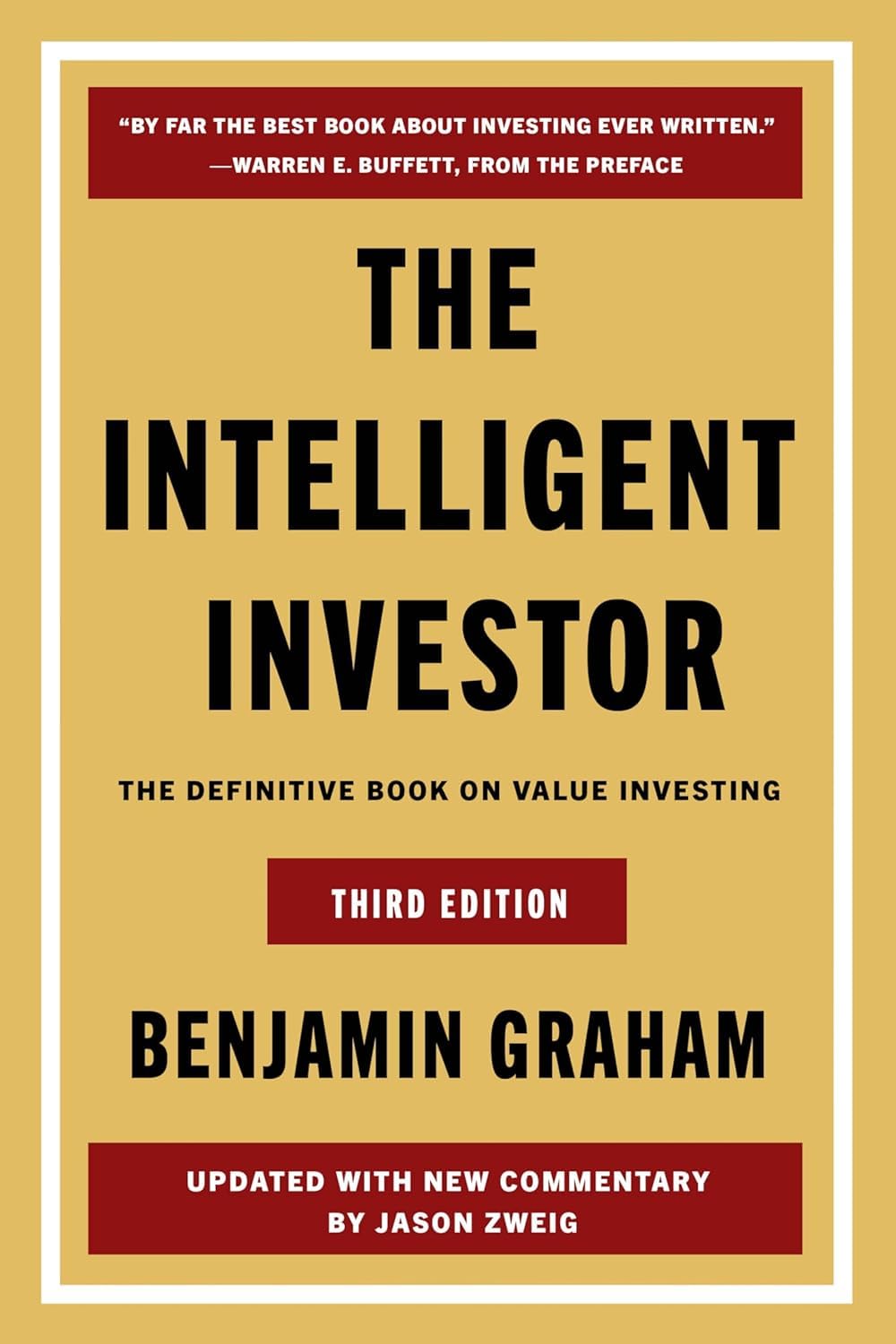
For over seven decades, Benjamin Graham’s The Intelligent Investor has stood as the definitive guide for prudent financial decision-making. Far from being a manual for quick riches, this book offers “a sound intellectual framework for making decisions and the ability to keep emotions from corroding that framework”.
Warren E. Buffett, one of Graham’s most famous students, declared that when he read the first edition in 1950, he thought it was “by far the best book about investing ever written,” a conviction he still holds true today. The text, which is designed to provide practical counsel, is aimed at laymen and focuses chiefly on investment principles and investor attitudes, rather than complex security analysis techniques.
The primary goal of The Intelligent Investor is three-fold:
- To minimize the odds of suffering irreversible losses.
- To maximize the chances of achieving sustainable gains.
- To control the self-defeating behavior that prevents most investors from reaching their full potential.
At its core, the book seeks to clarify and emphasize the distinction between investment and speculation—a difference that Graham believed was “now all but forgotten”. Graham warns readers immediately: “This is not a ‘how to make a million’ book. There are no sure and easy paths to riches on Wall Street or anywhere else”.
The Essential Philosophy: Character Over Calculations
Graham came to his profound insights the hard way, learning from decades of market history and firsthand experience with financial loss. His core principles are rooted not in complexity, but in common sense, and they remain equally valid today as they were during his lifetime.
Investment versus Speculation: The Defining Standard
Graham provides a clear and uncompromising definition of what constitutes an investment operation. As detailed in his textbook, Security Analysis, an investment operation is “one which, upon thorough analysis promises safety of principal and an adequate return. Operations not meeting these requirements are speculative”.
This definition is based equally on three elements:
- Thorough Analysis: This involves studying the facts in light of established standards of safety and value. You must analyze the company and the soundness of its underlying business before buying its stock.
- Safety of Principal: This means having protection against loss under all normal or reasonably likely conditions.
- Adequate Return: This refers to any rate of return the investor is willing to accept, provided they act with reasonable intelligence.
Graham observed that nearly all so-called “technical approaches” to trading follow the principle that one should buy because a stock or the market has gone up and sell because it has declined. This approach, however, is the “exact opposite of sound business sense everywhere else”.
The intelligent investor has no interest in being temporarily right; their goal is to be sustainably and reliably right to reach long-term financial goals. Many trendy speculative formulas that rose to prominence in the late 1990s—such as day trading, ignoring diversification, or following mechanical systems—failed because they violated at least one of Graham’s criteria for investing.
The True Meaning of Intelligence
The intelligence required for successful investing has “nothing to do with IQ or SAT scores.” It is defined by character traits: being patient, disciplined, eager to learn, and having the ability to harness your emotions and think for yourself. Graham suggests that an investor’s chief problem, and even their worst enemy, is usually themselves.
To highlight this distinction between intellectual brilliance and emotional discipline, the commentaries point to the example of Sir Isaac Newton. Newton, despite his extraordinary mind, lost a fortune in the South Sea Bubble by letting the “roar of the crowd override his own judgment,” acting like a fool in Graham’s terms.
The sources emphasize that readers should aim to establish the proper mental and emotional attitudes toward investment decisions. More money has been made and kept by “ordinary people” who were temperamentally well-suited for the investment process than by those with extensive financial knowledge who lacked this emotional quality.
The Investor and Market Fluctuations: The Mr. Market Parable
Chapter 8, which Warren Buffett recommends paying special attention to, contains arguably the most brilliant metaphor ever created for explaining how stocks can become mispriced: the Parable of Mr. Market.
Imagine you own a small share in a private business that cost you $1,000. One of your partners, Mr. Market, is extremely obliging:
- Every day, he tells you what he thinks your interest is worth.
- He offers to either buy you out or sell you an additional interest on that basis.
Sometimes, Mr. Market’s idea of value is justified by business prospects. Often, however, Mr. Market lets his enthusiasm or his fears run away with him, and the value he proposes seems silly.
The fundamental principle derived from this parable is straightforward: The investor should base his decisions on the perceived facts and sound analysis of the underlying business, not on Mr. Market’s manic-depressive mood swings. The intelligent investor should only deal with Mr. Market to the extent that it suits their book—either selling to him when he is overly enthusiastic (and prices are high) or buying from him when he is overly fearful (and prices are low).
When stock prices plunge, the typical investor feels fear, processed by the amygdala, generating a “fight or flight” response. This fear leads investors to sell low, converting paper losses into real ones. The intelligent investor, however, dreads a bull market since it makes stocks more costly to buy, and welcomes a bear market, since it puts stocks back on sale.
Graham sums up his lifetime of experience with this core wisdom: “The investor should concentrate his attention on the performance of his companies and the prices of his bonds and remember that market quotations are there for his convenience, either to be guided by them or to ignore them”.
Portfolio Policy: Designing Your Defensive and Enterprising Strategies
Graham distinguishes between two primary types of intelligent investors: the Defensive (Passive) investor and the Enterprising (Active or Aggressive) investor.
1. The Defensive Investor: Simplicity and Protection
The defensive investor emphasizes the avoidance of serious mistakes or losses, and seeks freedom from effort, annoyance, and the need for frequent decisions.
Asset Allocation: The 50/50 Formula
Graham suggests that most defensive investors follow a simplified formula: maintaining an approximately equal division between bond and stock holdings.
- The allocation should never be less than 25% in bonds or more than 75% in bonds (and vice versa for common stock).
- When market movements disturb the 50/50 balance by as much as 5%, the portfolio should be rebalanced (selling the higher component to buy the lower). For instance, if stocks rise to 55% of the portfolio, 1/11th of the stock component should be sold and the proceeds moved to bonds to restore the equality.
- This rebalancing should be done on a predictable schedule, such as every six months.
This simple framework helps investors replace guesswork with discipline.
Stock Selection for the Defensive Investor
Graham provides seven statistical requirements for the selection of common stocks by the defensive investor, emphasizing safety and quantity in terms of earnings and assets per dollar of price:
| Criterion | Description | Source |
|---|---|---|
| 1. Adequate Size | Should be a “large and prominent” company (today, defined by market capitalization of at least $10 billion). | |
| 2. Strong Financial Condition | For industrial companies, current assets should be at least double current liabilities (2:1 ratio). | |
| 3. Earnings Stability | No deficit in per-share earnings in the past ten fiscal years. | |
| 4. Dividend Record | Continuous dividend payments for at least the past 20 years. | |
| 5. Earnings Growth | A minimum increase of at least one-third in per-share earnings over the past ten years (comparing three-year averages at the beginning and end). | |
| 6. Moderate P/E Ratio | Current price should not be more than 15 times average earnings of the past three years. | |
| 7. Moderate Price/Asset Ratio | Current price should not be more than 1.5 times the reported book value (net tangible assets). |
Alternative: The Index Fund The easiest way for a defensive investor to execute a prudent portfolio policy today is by acquiring a diversified list of leading common stocks or simply buying a total stock-market index fund. Index funds offer the best tool for low-maintenance investing and generally beat the net results (after fees) delivered by the great majority of investment professionals.
2. The Enterprising Investor: Effort and Unpopularity
The enterprising (active) investor is willing to devote time and care to selecting securities that are both sound and more attractive than the average. To achieve better-than-average results, a policy must have a twofold merit:
- It must meet objective or rational tests of underlying soundness.
- It must be different from the policy followed by most investors or speculators (i.e., it must be unpopular).
Graham expressed doubt whether a truly substantial extra reward was promised to active investors under the conditions prevailing when he wrote the revised edition. Nevertheless, he recommended three specific areas for enterprising investment:
- Buying in Unpopular Large Companies: Finding companies that meet the defensive investor’s size and financial criteria but are selling at low multiples of earnings. These are fundamentally sound companies that the market, through waves of pessimism, has temporarily penalized.
- Buying Undervalued Secondary Companies (The “Net-Nets”): Graham’s classic approach involves seeking companies selling below their net-current-asset value (or “working capital value”). Net-current-asset value is calculated as current assets minus all total liabilities (including preferred stock and long-term debt). Buying a diversified group of such stocks at a price not more than two-thirds of this liquid value is a bargain approach that has consistently yielded good results.
- Special Situations (“Workouts”): These situations involve purchasing securities where the chance of a favorable outcome depends on an event like a tender offer, merger, or liquidation. These operations require skill and experience, but when conducted on a diversified basis, they can yield high returns.
The key message here is discipline: The enterprising investor must only embark on operations for which their training and judgment are adequate and that appear promising when measured by established business standards.
The Central Concept of Investment: Margin of Safety
If the secret of sound investment were to be distilled into three words, Graham ventures the motto: Margin of Safety. This is the thread running through all discussions of investment policy.
Defining Safety
The purpose of the margin of safety is to ensure that you minimize the odds of suffering irreversible losses. By refusing to pay too much for an investment, you protect yourself against the chance that your analysis of the future might be wrong.
In the context of common stocks, the margin of safety is achieved through buying the shares at a price sufficiently below the calculated value to allow for a large error of judgment. The greater the margin, the better the chance of gain. Graham compares this to the proprietor of a roulette wheel who bets on every number to ensure a profit, regardless of the spin.
Margin of Safety and Price
A security of mediocre quality can be turned into a sound investment opportunity if its price is low enough to create a substantial margin of safety, provided the buyer is informed and diversifies adequately.
- The future value of every investment is a function of its present price. The higher the price you pay, the lower your return will be.
- Insisting on a margin of safety minimizes your odds of error.
For example, real estate bonds in the 1920s sold at par and were recommended as sound investments but had little margin of value over debt. When they collapsed in the 1930s, the 90% price depreciation made many of those securities “exceedingly attractive and reasonably safe” because the true values were four or five times the market quotation.
Avoiding the Trap of Growth
Graham often warned against overpaying for anticipated growth. “Obvious prospects for physical growth in a business do not translate into obvious profits for investors”. Even excellent prospects for future growth do not justify paying an excessive price, because that valuation introduces a highly speculative element.
Graham’s greatest error as an investor involved insisting on a margin of safety on a stock that later became his most spectacular gain: GEICO. Graham and his partner purchased a half-interest in GEICO at a moderate price relative to current earnings and asset value. The deal almost fell through because the partners insisted that the purchase price be 100% covered by asset value. This was a decisive factor, even though the price advanced two hundredfold later, eventually far outstripping the growth in profits.
This experience confirms the principle: Even if you miss out on spectacular gains by being too cautious, focusing on protection—the Margin of Safety—is the surest way to achieve satisfactory long-term results.
The Best Defense
The margin of safety principle ensures that the intelligent investor focuses not on predicting the future—which is impossible and unreliable—but on protecting against the consequences of being wrong.
As eloquently summarized in the commentaries, this is akin to Pascal’s Wager. The investor, like the gambler, must focus on the consequences of failure because the probability of making mistakes is virtually 100%. By keeping holdings permanently diversified and refusing to chase the market’s craziest fashions, the investor ensures that the consequences of any individual mistake will never be catastrophic.
Final Thoughts: The Timeless Lessons
The Intelligent Investor provides timeless counsel, teaching readers to adopt a businesslike attitude toward their investments. The principles advocated by Graham—especially the invaluable advice in Chapters 8 (Mr. Market) and 20 (Margin of Safety)—guarantee that the disciplined investor will “not get a poor result from your investments”.
Ultimately, the book implants in the reader a tendency to “measure or quantify”—to relate what is paid to what is being offered. The truly dreadful losses in the stock market have always been realized when the buyer forgot to ask the crucial question: “How much?”.
Graham was more than an author or a teacher; he provided the structure and logic to an activity that was often disorderly and confused. His principles have remained sound, their value often enhanced in the wake of financial storms that demolished flimsier intellectual structures. Follow Graham and you will profit from folly rather than participate in it.
Watch the Summary of the Book on Youtube and also the Audio Summary below. ENjoy

 Best Books to Read and Listen