
The Intelligent Investor’s Toolkit: Understanding Value Investing Through Security Analysis
Welcome to the heart of financial wisdom!
If you’ve ever felt overwhelmed by the relentless churn of the stock market—the confusing headlines, the panic-driven selling, and the euphoria-driven bubbles—you are not alone. Many investors mistake gambling for investing, chasing rapid gains based on fleeting tips or emotional reactions.
But what if I told you there is a systematic, proven method for separating genuine financial opportunity from mere speculation?
The key lies in a discipline called Security Analysis. And the text that formalized this discipline, laying the foundation for modern investing, is the magnum opus, Security Analysis: Principles and Technique.
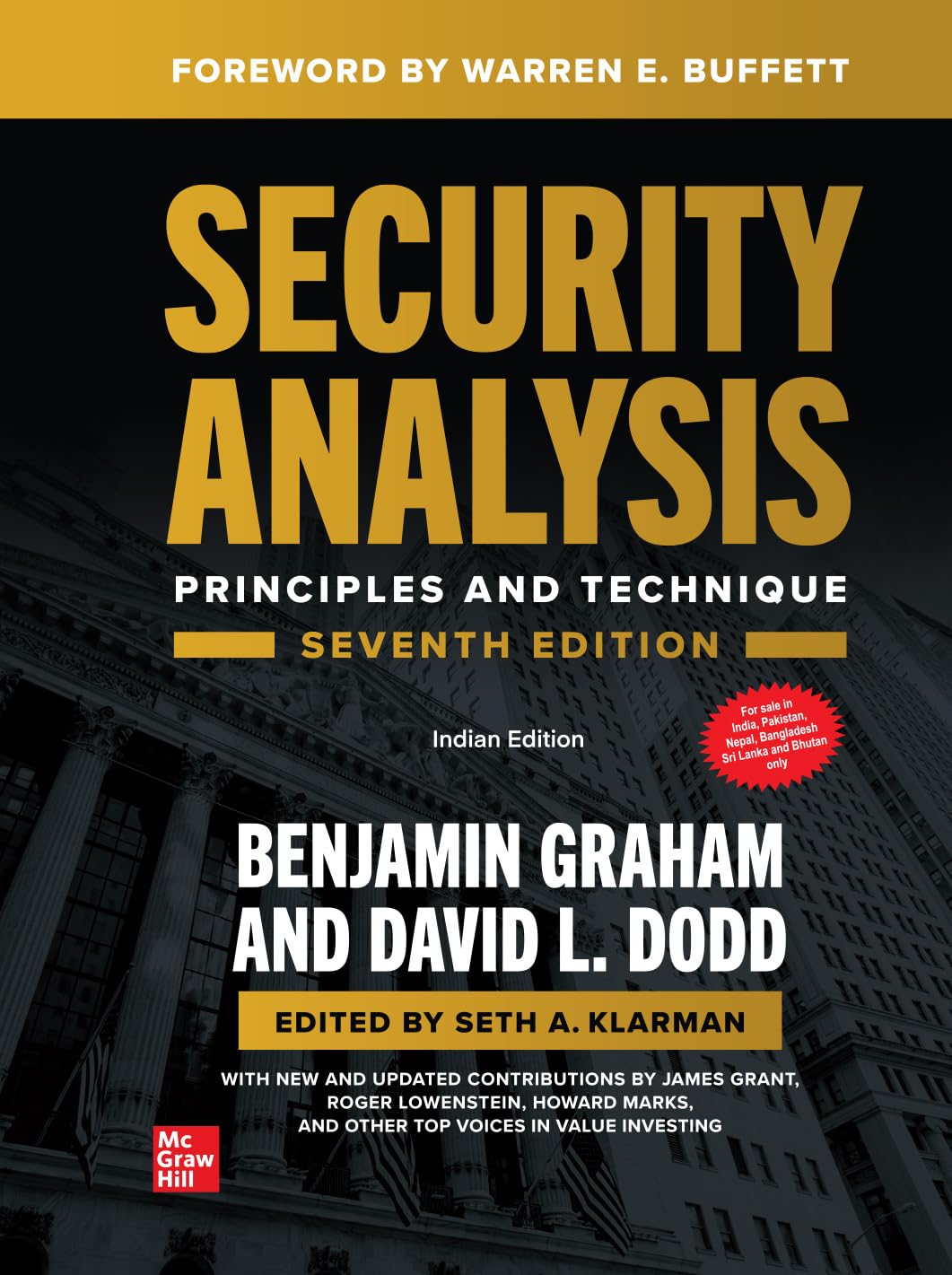
This book is often called the “Bible of Value Investing” for a reason. While the details of the “Principles and Technique” are contained within its pages (not the cover images provided), we can draw upon the fundamental concepts it introduced to understand how professional analysts and legendary investors approach the market.
The Architects of Financial Thought: Graham and Dodd
The original genius behind this work were Benjamin Graham and David L. Dodd. Writing during the tumultuous 1930s, they distilled years of financial experience into a structured, logical process.
Benjamin Graham, in particular, is widely hailed as the father of value investing. He taught a rigorous, almost scientific approach to the stock market, treating a share of stock not as a ticker symbol to be traded, but as a proportionate ownership stake in an actual business.
This philosophy is so powerful that it continues to shape the strategies of today’s market leaders. The sources confirm that the ongoing relevance of this work is cemented by the existence of the Seventh Edition, which features contributions and endorsements from modern titans of finance.
The Guiding Lights of the Seventh Edition
The persistence of this text is no accident. The Seventh Edition was edited by Seth A. Klarman, a highly regarded investor known for managing the Baupost Group and strictly adhering to value investing principles.
Furthermore, the book carries immense authority:
- It includes a Foreword by Warren E. Buffett. Buffett, the CEO of Berkshire Hathaway and one of the world’s wealthiest people, famously studied under Graham at Columbia University.
- The text is updated with new and updated contributions from respected authors and investors, including James Grant, Roger Lowenstein, Howard Marks, and other top voices in value investing.
This array of authoritative figures confirms that the principles laid out by Graham and Dodd remain the essential core of sound investment strategy, proving that the basic tools of analysis transcend technological shifts and market trends.
Part I: Investment vs. Speculation – A Critical Distinction
To grasp security analysis, you must first internalize Graham’s fundamental premise: Investing is not speculation.
Graham defined investment as an operation that, upon thorough analysis, promises safety of principal and a satisfactory return. Operations that fail to meet these requirements are speculative.
This distinction is crucial because it governs the entire analytical mindset:
- The Speculator focuses on the price of a stock, often hoping it goes up next week or next month due to momentum, a news event, or market sentiment.
- The Investor focuses on the value of the business itself, ensuring that if they buy it, they are paying a reasonable price relative to the company’s underlying assets and earning power.
Security analysis is simply the detailed process the investor uses to arrive at that fundamental value. It demands intellectual honesty, discipline, and, most importantly, emotional detachment from market noise.
The Three Pillars of Value Investing
If we distill the thousands of pages within Security Analysis into simple, actionable concepts, we arrive at three pillars that every layman must understand:
- The Margin of Safety.
- Intrinsic Value.
- The Parable of Mr. Market.
Part II: The Margin of Safety – Your Financial Armor
If value investing has one core commandment, it is this: Thou Shalt Demand a Margin of Safety.
What exactly is the Margin of Safety?
It is the principle of only purchasing an investment when the market price is significantly lower than the determined intrinsic value.
Imagine you estimate a house is truly worth $500,000 (its intrinsic value). If you buy it for $490,000, your margin of safety is small ($10,000). But if you have the patience to wait and buy the exact same house for $350,000, your margin of safety is $150,000, or 30%.
Why the Margin of Safety is Essential:
- Protection Against Errors: Even the best analysts make mistakes. Market forecasts are imperfect, management teams can underperform, and economic conditions can worsen unexpectedly. The margin of safety is your cushion against these unpredictable negative events. If you bought the $500,000 house for $350,000, the market value could drop dramatically (say, to $400,000) before you even begin to lose money.
- A Source of Profit: When the market eventually recognizes the true intrinsic value of the business, the stock price will rise to meet that value. The greater your initial margin of safety, the higher your eventual percentage return.
- Defining the Investor: Speculators chase high-growth stocks with zero margin of safety, betting on everything going perfectly. Investors, using security analysis, only buy where the risk is minimized by this built-in safety net.
The search for a margin of safety forces the investor to be contrarian—to buy when others are fearful or when a company is temporarily unpopular, driving its price down below its true worth.
Part III: Intrinsic Value – Finding the True Worth
If the margin of safety is the armor, the Intrinsic Value is the quarry. Security analysis is the sophisticated technique used to estimate this true worth.
Intrinsic value is the economic worth of the business based on a careful assessment of its assets, earnings, dividend potential, and qualitative factors (like management quality or industry stability). It is what the business would be worth if you owned the entire thing and ran it for the long term.
For the layman, understanding intrinsic value requires a simplified look at the financial statements:
1. Balance Sheet Analysis (What the Company Owns and Owes)
Graham emphasized the importance of the balance sheet, especially in finding “bargain issues”—companies trading at prices below the value of their readily accessible assets.
- Net Current Asset Value (NCAV): The most conservative valuation tool Graham used was calculating NCAV (often called “Net-Nets”). This involved taking the current assets (cash, inventory, receivables) and subtracting all liabilities (both current and long-term). If the stock market price was less than this highly liquid value, it was considered an exceptionally safe bargain.
- Liquidation Value: This estimates the cash that would be left over if the company were immediately shut down, assets sold, and debts paid off. Security analysis demands paying less than this liquidation value, ensuring an inherent safety net.
2. Earnings and Cash Flow Analysis (What the Company Generates)
While assets provide protection, the ability to generate future profits drives growth.
- Stability and Duration of Earnings: Security analysts look for consistent, reliable earning power over a period of years, rather than a single extraordinary year. The technique involves normalizing earnings to account for business cycles.
- Debt Ratios: Excessive debt compromises the safety of principal. Analyzing debt-to-equity and interest coverage ratios is critical. Graham’s principles dictate that a company must be able to withstand challenging economic times without collapsing under its debt obligations.
A Modern Caveat (External Information):
While Graham’s initial analysis focused heavily on tangible assets and current balance sheet numbers, modern security analysis, especially the approach used by Seth Klarman and Warren Buffett, must also incorporate “intangible” assets like brand value, network effects, and intellectual property—especially for technology companies. However, the core principle remains: Value is determined by facts and logic, not excitement.
Part IV: Mr. Market – The Temperamental Partner
Perhaps the most famous and accessible contribution of Graham to the layman is the Parable of Mr. Market.
Imagine you own a share of a private business with a partner named Mr. Market. Every single day, without fail, Mr. Market knocks on your door and offers to either buy your share or sell you his share, based on the price he sets that day.
The catch? Mr. Market is intensely manic-depressive.
- On some days, Mr. Market is euphoric, only seeing the fantastic potential of the business. He quotes you an extremely high price.
- On other days, Mr. Market is terrified, focused only on short-term troubles, global recession fears, or rumors. He quotes you a ridiculously low price.
The genius of this parable is its lesson on emotional control: You are under no obligation to transact with Mr. Market.
The Analyst’s Response to Mr. Market:
The disciplined security analyst treats Mr. Market not as a guide, but as a servant [Graham’s philosophy].
- Exploit Him: When Mr. Market is depressed (offering a low price), the investor uses security analysis to verify the intrinsic value, demands a margin of safety, and buys.
- Ignore Him: When Mr. Market is euphoric (offering a high price), the investor may sell or simply ignore the temporary valuation, knowing that short-term volatility does not change the long-term earning power of the business.
This concept liberates the investor from the tyranny of daily price fluctuations. If you know what a business is worth through rigorous analysis, the daily market price becomes merely a source of opportunity, not a cause for anxiety.
Part V: Principles for the Layman Investor
How does this complex Principles and Technique translate into actionable steps for someone just starting out? Graham and Dodd’s teachings offer a clear blueprint for constructing a portfolio based on analysis, not hope.
1. Analysis of Fixed-Income Securities (Bonds)
Security analysis places safety of principal first. For bonds, analysis focuses intensely on the issuer’s ability to pay interest and repay the principal.
- Earning Power Test: The company must demonstrate that its average earnings over the past several years significantly exceed its interest payments. This ratio (times interest earned) must provide a comfortable margin of safety.
- Asset Coverage Test: The company’s net tangible assets must substantially exceed the total value of its debt.
Graham taught that a bond, by its nature, must provide safety. If analysis suggests high risk, the security should be rejected entirely, as a bond provides limited upside to compensate for substantial risk.
2. Analysis of Common Stocks (Equities)
For common stocks, Graham separated analysis into two categories:
A. Defensive Investing (The Conservative Approach)
The defensive investor seeks minimum effort and minimum risk. Security analysis recommends strict, easily quantifiable criteria for these stocks:
- Adequate Size: Companies must be large and prominent enough to have demonstrated stability.
- Strong Financial Condition: Low debt relative to assets and robust current assets.
- Stable Earnings and Dividends: Continuous dividend payments and consistent profitability for a specified period (e.g., 20 years).
- Reasonable Price: The price paid should be strictly limited relative to earnings and book value to maintain a built-in margin of safety.
This approach minimizes the need for complex, day-to-day analysis.
B. Enterprising Investing (The Active Approach)
The enterprising investor is willing to dedicate more time to analysis to find special opportunities. This involves:
- Buying Bargain Issues: Finding “Net-Nets” (companies trading below their liquid asset value). This requires deep analysis of footnotes and balance sheet details.
- Buying Unpopular Large Companies: Identifying fundamentally strong, large companies that are currently undervalued due to temporary bad news, industry-wide pessimism, or poor market optics.
- Special Situations: Analyzing corporate actions like mergers, spinoffs, or restructurings that unlock underlying value.
In all cases, the decision to buy is driven by calculation of value, not speculation on momentum.
Part VI: The Enduring Legacy in the Modern Era
Why, nearly a century after its inception, is Security Analysis still being revised and championed by editors like Seth A. Klarman and contributors like Howard Marks and Roger Lowenstein?
The principles of Graham and Dodd are timeless because human psychology, corporate finance, and the laws of arithmetic have not changed. While technology companies and derivative markets introduce complexity, the core task remains constant: separating price from value.
Applying Classic Analysis to Modern Markets (External Information):
- Focus on Cash Flow over Earnings: While Graham focused on reported earnings, contemporary analysis emphasizes free cash flow (the cash a company generates after accounting for maintenance costs). A business is only truly valuable if it generates usable cash for its owners.
- Valuing Intangibles: Modern analysts must use conservative assumptions when valuing intangible assets (like the technology platform of a software company or the brand equity of an apparel retailer). The margin of safety is applied even more aggressively here due to the subjectivity involved.
- Discipline in Volatility: The internet age means Mr. Market knocks on our door 24/7 with instant price quotes. The necessity for the investor to maintain a detached, analytical mindset—as prescribed by Graham—is greater than ever.
The Seventh Edition, with its updated contributions, serves as a crucial bridge, showing how to apply the stringent, fact-based criteria of Graham and Dodd to companies operating in an environment they never could have imagined. It ensures that the basic concept of buying a dollar’s worth of value for fifty cents remains the guiding light.
Conclusion: The Path of Discipline
Security analysis is not a get-rich-quick scheme. It is a philosophy of patience, discipline, and profound skepticism. It requires you to look past the noise, ignore the crowd, and spend the necessary intellectual energy to understand the true economic engine running beneath the stock price.
As confirmed by the sources, the endorsement of figures like Warren E. Buffett proves that the analytical techniques laid out by Graham and Dodd are the strongest possible foundation for any serious investor.
To become an intelligent investor, you must arm yourself with knowledge. You must conduct your own analysis, demand a margin of safety, and only buy when Mr. Market is having one of his depressive episodes.
Mastering security analysis is like learning to read a complex architectural blueprint. Once you understand the structure, you stop worrying about the paint color and focus only on the foundation—and a strong foundation is what keeps your investment portfolio standing tall, regardless of the storms the market throws at it.

 Best Books to Read and Listen