
The Inner Creative Battle: How to Break Through Resistance and Win The War of Art
Keywords: Resistance, Creative Blocks, Turning Pro, Steven Pressfield, Creative Battles, Professionalism, The War of Art, Procrastination, Inner Genius.
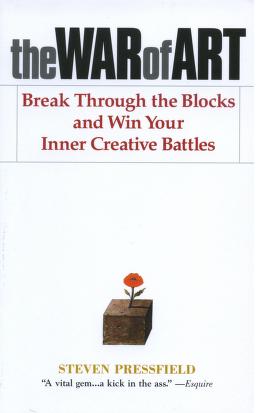
In the journey of creation, whether you are launching a startup, painting a masterpiece, or simply committing to a healthier life, there is an ubiquitous, invisible enemy: Resistance. Steven Pressfield, author of internationally bestselling novels such as The Legend of Bagger Vance and Gates of Fire, defined this toxic force in his insightful work, The War of Art: Break Through the Blocks and Win Your Inner Creative Battles. This text is not merely a book; it is a vital gem and “a kick in the ass” that defines the adversary we all face when we attempt to pursue a tough, long-term course of action that might actually be good for us or others.
The secret that real writers, artists, and entrepreneurs know—which those who merely wish to succeed do not—is that the most challenging part is not the execution of the work itself, but sitting down to start. What keeps us from sitting down is Resistance. This blog post serves as a guide, drawing directly from the fundamental concepts of The War of Art, to help you define this enemy, understand its manifestations, adopt the professional mindset necessary for victory, and finally access the “Higher Realm” of inspiration.
Part One: Defining the Enemy – What is Resistance?
Resistance is Pressfield’s all-encompassing term for the destructive force inside human nature—what Freud referred to as the Death Wish—that invariably arises when we contemplate a difficult, sustained action leading to positive results.
It is the enemy within; it is self-generated and self-perpetuated. Resistance cannot be seen, touched, heard, or smelled, but its energy field can be intensely felt, radiating from a work-in-potential. It operates as a repelling, negative force aimed at shoving us away and distracting us from our crucial work.
The True Nature of Resistance
Resistance is not merely a mild inconvenience; it is an implacable and intractable engine of destruction. It is programmed with the single object of preventing us from doing our work. Pressfield compares Resistance to villains like the Alien, the Terminator, or the shark in Jaws—it cannot be reasoned with, and it understands nothing but power.
This force is deeply toxic, considered the root of more unhappiness than poverty, disease, and erectile dysfunction. To yield to Resistance stunts us, deforms our spirit, and prevents us from achieving the life God intended when He endowed us with our unique genius. The Latin word genius refers to an inner spirit, holy and inviolable, guiding us to our calling; Resistance is genius’s shadow.
Resistance is universally experienced by everyone who has a body. It operates impersonally, like a force of nature, with the indifference of rain.
The Compass of Creation
Paradoxically, Resistance serves as a valuable tool. Like a magnetized needle, Resistance unfailingly points to True North—that calling or action it most desperately wants to stop us from doing.
We can use Resistance as a compass. The rule of thumb is clear: The more important a call or action is to our soul’s evolution, the more Resistance we will feel toward pursuing it. For instance, if you find yourself asking, “Am I really a writer?” or if you are paralyzed with fear about a project, these are good signs, acting as indicators of aspiration and confirming that you must pursue that path.
Resistance’s ultimate aim is not just to disable but to kill our unique gift. When we fight it, we are in a war to the death. However, Resistance has no inherent strength; every ounce of power it possesses comes from us, fed by our fear of it.
Part Two: The Manifestations of the Enemy
Resistance is protean; it will assume any form, perjure, fabricate, falsify, seduce, bully, or cajole if that’s what it takes to deceive you. It is always lying and “always full of shit”.
Activities that commonly elicit Resistance include, but are not limited to:
- The pursuit of any creative art: Writing, painting, music, film, or dance.
- Launching any entrepreneurial venture.
- Any diet or health regimen, or program of spiritual advancement.
- Any course designed to overcome an unwholesome habit or addiction.
- Any act that entails commitment of the heart: Marriage, having a child, or weathering a rocky patch in a relationship.
Essentially, any act that rejects immediate gratification in favor of long-term growth, health, or integrity—anything deriving from our higher nature instead of our lower—will elicit Resistance.
Resistance’s Greatest Hits
1. Procrastination: Procrastination is the most common and easiest-to-rationalize manifestation of Resistance. We rationalize by saying we will start tomorrow, avoiding the shame of admitting we will never write the symphony. The most pernicious aspect is that it can become a habit, postponing our lives until our deathbed. The good news is that we can change our destiny and sit down to work this very second.
2. Addictions and Quick Fixes: Resistance often takes the form of seeking immediate and powerful gratification, such as through excessive sex, drugs, shopping, or the consumption of products containing fat, sugar, salt, or chocolate. These are cheap, easy fixes that distract us from doing our work, leaving a sense of hollowness afterward.
3. Trouble and Self-Dramatization: It is often easier to create trouble—like getting busted, developing neuroses, or succumbing to addiction—than it is to accomplish demanding creative tasks, such as finishing a dissertation. Creating “soap opera” in our lives, fueling perpetual drama, is a key symptom of Resistance, guaranteeing that “Nobody gets a damn thing done”. The working artist understands that trouble prevents her from doing her work and will banish all sources of trouble from her world.
4. Victimhood: Self-dramatization often leads to casting oneself as a victim, which is the antithesis of doing creative work. Victimhood is a form of passive aggression that seeks gratification through the manipulation of others rather than through honest work or contribution. It is a shadow version of the real creative act the victim is avoiding.
5. Seeking Support and Healing: The idea that one needs to complete psychic “healing” before being ready to do the work is a form of Resistance. The part of us that creates is far deeper and stronger than the part that needs healing; it is “unsullied, uncorrupted”. Resistance loves healing, workshops, and seeking support because the more psychic energy we expend dredging up personal injustices, the less “juice” we have to do our work. Any support received from friends and family is like Monopoly money—it’s not legal tender in the sphere where the work must be done.
6. Rationalization: Rationalization is Resistance’s right-hand man, designed to keep us from feeling the shame of being cowards for not doing our work. Resistance uses rationalization as a “spin doctor,” presenting plausible and legitimate justifications for why we should delay—such as a heavily pregnant spouse or departmental changes. However, Resistance leaves out that these legitimate obstacles “mean diddly” in the face of true dedication; for example, Tolstoy wrote War and Peace while having thirteen children.
Adversaries and Allies
Resistance also recruits allies in the form of sabotage by others. When an artist starts to overcome Resistance, close friends or family may act strangely, becoming moody or sullen, because the artist’s success becomes a reproach to their own un-conquered Resistance. The highest treason a crab can commit is to make a leap for the rim of the bucket. The best thing an artist can do for struggling friends is to serve as an example and keep moving forward.
Part Three: Combating Resistance – Turning Pro
If Resistance is the enemy, then Professionalism is the battle plan and the vision of victory. The amateur thinks Resistance can be overcome by waiting until fear is gone; the professional knows fear never goes away. Instead, the professional acts in the face of fear.
Turning pro is an epochal moment—a decision brought about by an act of will. The term “professional” here doesn’t refer to doctors or lawyers, but to the professional as an ideal, in contrast to the amateur.
| Characteristic | The Amateur | The Professional |
|---|---|---|
| Focus | Plays for fun. | Plays for keeps. |
| Commitment | Part-time, a sideline. | Full-time, dedicating their life to it. |
| Identity | Overidentifies with the art, paralyzed by fear of failure. | Does not overidentify; sees work as a job description. |
| Daily Habit | Does not show up every day, or stay on the job all day. | Shows up every day, no matter what, and stays all day. |
The professional is not defined by money, but by commitment. The word amateur comes from the Latin root meaning “to love,” but the professional loves the game so much he dedicates his life to it full-time.
The Professional’s Code of Necessity
The professional adheres to a rigorous code, dictating that the battle against Resistance must be fought anew every single day.
1. Focus on the Craft (Mastering Technique): First, last, and always, the professional focuses on the mastery of craft. A pro views work as craft, not art. She concentrates on the how—technique—and leaves the what and why to the gods. The professional knows that by toiling beside the front door of technique, she leaves room for genius to enter by the back. She doesn’t wait for inspiration; she acts in anticipation of its appearance.
2. Patience and Order: The professional arms himself with patience, understanding delayed gratification. He views the project as the Iditarod, not the sixty-yard dash, conserving energy for the long haul. Furthermore, the professional seeks order, eliminating chaos from his world to banish it from his mind, ensuring the Muse may enter and not soil her gown.
3. Showing Up and Putting in Time: The working artist maintains a strict schedule, like Somerset Maugham, who famously replied when asked if he wrote only when inspiration strikes: “Fortunately it strikes every morning at nine o’clock sharp”. This mundane physical act sets in motion an infallible sequence that produces inspiration. The focus is on putting in the time and overcoming Resistance for that session, not on judging the quality or quantity of pages produced.
4. Enduring Misery and Humiliation: Committing to one’s calling means volunteering for hell, involving a diet of isolation, rejection, self-doubt, despair, and ridicule. Pressfield, drawing on his experience in the Marine Corps, notes that the artist must learn how to be miserable and take pride in it. When facing adversity or humiliation—such as a producer forgetting a scheduled meeting—the professional cannot take it personally, recognizing that humiliation is merely the external reflection of internal Resistance.
5. Self-Validation and Objectivity: The professional self-validates and does not allow external criticism (even if true) to fortify the internal foe. She accepts that she has a right only to her labor, not the fruits of her labor, as taught by the Bhagavad-Gita. The professional assesses her work coldly, determining where it fell short and how to improve it, ready to return tomorrow.
6. Distancing from the Instrument: The professional does not identify with her instrument (her body, voice, talent) but rather assesses it coolly, impersonally, and objectively. She identifies with her consciousness and her will. Thinking of oneself as a corporation—”Myself, Inc.”—reinforces this professionalism by separating the artist-doing-the-work from the will-and-consciousness-running-the-show.
Part Four: Beyond Resistance – The Higher Realm
When we sit down each day and keep grinding, a mysterious process begins: “heaven comes to our aid”. Unseen forces enlist in our cause; the Muse takes note of our dedication and approves. This sublime result, which blossoms in the furrows of the professional, is Inspiration.
Pressfield acknowledges that this realm involves invisible psychic forces, which may be conceptualized as muses, angels, or simply as talent programmed into our genes. What matters is recognizing that these counter-forces exist, poised against Resistance, and they are our allies.
The Battle Between Ego and Self
The ultimate creative battle is fought between two internal forces:
- The Ego: The part of the psyche that believes exclusively in material existence. It believes death, time, and space are real, and that the predominant impulse of life is self-preservation, leading us to act out of fear. The Ego is the seat of Resistance and hates the Self because when we reside in the Self, the Ego is put out of business; it doesn’t want us to evolve.
- The Self: A greater entity, incorporating the Ego, but also the Personal and Collective Unconscious—the sphere of the soul. The Self believes death, time, and space are illusions, and that the supreme emotion is love (union and mutual assistance). The Self is united to God and speaks for the future. Dreams, ideas, and intuitions come from the Self, and when we alter our consciousness (through meditation, prayer, or fasting), we seek the Self.
The Ego throws up fears—fear of poverty, failure, being selfish, or betraying family—to keep us locked down. But the Master Fear is the fear of success. We fear that we can actually access the powers we secretly possess and become the person we truly are. This fear is primal, rooted in the terror of becoming estranged from the tribe and losing all we know.
However, when we embrace our ideals and “pass through a membrane,” we do not wind up alone. Instead, we become “tapped into an unquenchable, undepletable, inexhaustible source of wisdom, consciousness, companionship”.
The Territorial Imperative
The professional artist must reject the hierarchical orientation, which is fatal to creation.
- Hierarchy defines individuals by their rank within a pecking order (like high school or Hollywood). In a hierarchy, one competes against all others, evaluates success by rank, and acts toward others based on their rank. The artist looks outward, asking: “What can this person do for me?”. The hack writer writes hierarchically, second-guessing the audience based on what they imagine will sell, thereby selling out their Muse.
- Territory defines individuals by their connection to a home base or turf, which provides psychological security. The artist must operate territorially, doing the work for its own sake, not for fortune or attention.
Our territory is psychological. Examples include the gym (Arnold Schwarzenegger’s territory) or the piano (Stevie Wonder’s territory).
A territory has specific qualities:
- It provides sustenance: The artist feels restored by the act itself.
- It sustains without external input: It is a closed feedback loop where effort and love are absorbed and given back as well-being.
- It can only be claimed alone: You only need yourself to soak up its juice.
- It can only be claimed by work: A territory doesn’t give; it gives back, requiring hours and years of sweat to claim.
- It returns exactly what you put in: It is fair, never devaluing or crashing.
The act of creation is territorial. When the artist works territorially, she aligns herself with the mysterious forces that seek to bring new life through her.
A simple test to check your orientation: If you were the last person on earth, would you still pursue your activity? If the sustenance comes from the act itself, you are working territorially.
The Ultimate Goal: An Offering
Beyond working territorially, there is a third way: doing the work and giving it to God as an offering. The work comes from heaven anyway, so acknowledging this effaces all ego, purges pride and preciousness, and allows the artist to become a willing and skilled instrument of the gods and goddesses they serve.
This approach—acting as a mercenary or gun for hire who simply shows up to serve the Muse—implants the proper humility, which Resistance hates. The professional is humble because they know they are not the source of their creations; they only facilitate and carry the work.
Conclusion: The Necessity of Action
The question of whether you are meant to be a writer, painter, or entrepreneur can only be answered by action.
Creative work is not a selfish act or a bid for attention; it is a gift to the world and every being in it. If you were meant to cure cancer or write a symphony and you do not do it, you hurt yourself, your loved ones, and the planet.
Steven Pressfield urges us to remember the elemental truth concerning all acts of initiative and creation, articulated by W. H. Murray: that the moment one definitely commits oneself, then providence moves too. A whole stream of events issues from the decision, raising in one’s favor all manner of unforeseen incidents and material assistance.
Do not cheat the world of your contribution. Give us what you’ve got.
As Goethe once wisely stated: “Whatever you can do, or dream you can, begin it. Boldness has genius, magic, and power in it. Begin it now”.
If you are currently paralyzed with fear, recognize that fear is merely Resistance. Master that fear, and you conquer Resistance. Sit down and do your work. The professional keeps coming on, beating Resistance by being even more resolute and implacable than it is, “just as sure as the turning of the earth”.
The battle is inside our own heads. Go forth and win the war.

 Best Books to Read and Listen