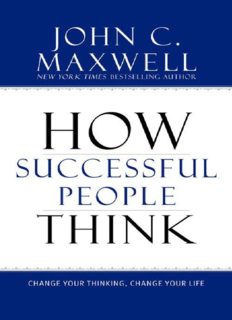
How Successful People Think: Change Your Thinking, Change Your Life by John C Maxwell

HOW SUCCESSFUL PEOPLE THINK : CHANGE YOUR THINKING, CHANGE YOUR LIFE BY JOHN C MAXWELL

Wall Street Journal bestseller, HOW SUCCESSFUL PEOPLE THINK is the perfect, compact read for today’s fast-paced world. America‘s leadership expert John C. Maxwell will teach you how to be more creative and when to question popular thinking. You’ll learn how to capture the big picture while focusing your thinking. You’ll find out how to tap into your creative potential, develop shared ideas, and derive lessons from the past to better understand the future. With these eleven keys to more effective thinking, you’ll clearly see the path to personal success.

John C. Maxwell points out in his book that those missing links, can be further exhibited through the 11-skillset program one should strive to possess:

  • Seeing the Wisdom of Big-Picture Thinking
  • Unleashing the Potential of Focused Thinking
  • Discovering the Joy of Creative Thinking
  • Recognizing the Importance of Realistic Thinking
  • Releasing the Power of Strategic Thinking
  • Feeling the Energy of Possibility Thinking
  • Embracing the Lessons of Reflective Thinking
  • Questioning the Acceptance of Popular Thinking
  • Encouraging the Participation of Shared Thinking
  • Experiencing the Satisfaction of Unselfish Thinking
  • Enjoying the Return of Bottom-Line Thinking

If you take a critical view of this methodology, you’ll come to the conclusion that the big picture, is more important than short-term achievement.

Big-time achievers are learning-machines, to say the least. They are never pleased with the knowledge they have, and they strive to learn as they go.

An extraordinary method of expanding your horizons is nurturing the habit of listening. If you plan on making strides towards excellence, you should really consider the fact that you don’t know everything. The expertise of others can be of particular use to you if you’re open-minded.

Big-picture thinkers recognize that they don’t know lots of things. They frequently ask penetrating questions to enlarge their understanding and thinking. If you want to become a better big-picture thinker, then become a good listener.

Intuitively, you probably recognize big-picture thinking as beneficial. Few people want to be closed-minded. A  one sets out to be that way.

John even presents a formula that acts as a proof of how crucial your environment is in the pursuit of prosperity:

The Right Thought plus the Right People
in the Right 
Environment at the Right Time
for the Right 
Reason = the Right Result

Key Lessons from “How Successful People Think”

  1.       Become a successful thinker
  2.      Start listening; there are a lot of smart people out there
  3.      Read, read, and read some more.


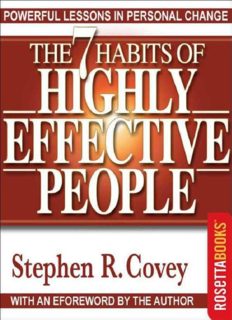
The 7 Habits of Highly Effective People by Stephen R Covey , Sean Covey

THE 7 HABITS OF HIGHLY EFFECTIVE PEOPLE 
BY STEPHEN R COVEY, SEAN COVEY

The 7 Habits have become famous and are integrated into everyday thinking by millions and millions of people. Why? Because they work!

With Sean Covey’s added takeaways on how the habits can be used in our modern age, the wisdom of the 7 Habits will be refreshed for a new generation of leaders.

Covey’s seven habits are composed of the primary principles of character upon which happiness and success are based. The 7 Habits of Highly Effective People puts forward a principle-centered approach to both personal and interpersonal effectiveness. Rather than focusing on altering the outward manifestations of your behavior and attitudes, it aims to adapt your inner core, character, and motives.

The seven habits in this book will help you move from a state of dependence, to independence, and finally to interdependence. While society and most of the self-help books on the market champion independence as the highest achievement, Covey argues that it’s interdependence that yields the greatest results. 

Interdependence is a more mature, advanced concept. It precludes the knowledge that you are an independent being, but that working with others will produce greater results than working on your own. To attain this level of interdependence, you must cultivate each of the seven habits laid out in the book. 


They include:


Habit 1: Be Proactive  
More than just taking the initiative, being proactive means taking responsibility for your life. Consequently, you don’t blame your behavior on external factors such as circumstances, but own it as part of a conscious choice based on your values. Where reactive people are driven by feelings, proactive people are driven by values.

Habit 2: Begin with the End in Mind.  
To better understand this habit, Covey invites you to imagine your funeral. He asks you to think how you would like your loved ones to remember you, what you would like them to acknowledge as your achievements, and to consider what a difference you made in their lives. Engaging in this thought experiment helps you identify some of your key values that should underpin your behavior. Covey states that the most effective way to begin with the end in mind is to create a personal mission statement. It should focus on the following:
    • What you want to be (character)
    • What you want to do (contributions and achievements)
    • The values upon which both of these things are based

Habit 3: Put First Things First. 
This means cultivating the ability to say no to things that don’t match your guiding principles. To manage your time effectively in accordance with habit three, your actions must adhere to the following:
    1. They must be principle-centered.
    2. They must be conscience-directed, meaning that they give you the opportunity to organize your life in accordance with your core values.
    3. They define your key mission, which includes your values and long-term goals.
    4. They give balance to your life.
    5. They are organized weekly, with daily adaptations as needed.


Habit 4: Think Win/Win  To be an effective win/win leader, Covey argues that you must embrace five independent dimensions:

    1. Character: This is the foundation upon which a win/win mentality is created, and it means acting with integrity, maturity, and an “abundance mentality” (i.e., there is plenty of everything for everyone, one person’s success doesn’t threaten your success).
    2. Relationships: Trust is essential to achieving win/win agreements. You must nourish your relationships to maintain a high level of trust.
    3. Agreements: This means that the parties involved must agree on the desired results, guidelines, resources, accountability, and the consequences.
    4. Win/win performance agreements and supportive systems: Creating a standardized, agreed-upon set of desired results to measure performance within a system that can support a win/win mindset.
    5. Processes: All processes must allow for win/win solutions to arise.

Habit 5: Seek First to Understand, Then to Be Understood. 

If you want to improve your interpersonal relations, Covey argues that you must endeavor to understand a situation before attempting to make yourself understood. The ability to communicate clearly is essential for your overall effectiveness, as it’s the most important skill you can train. While you spend years learning to read, write, and speak, Covey states that little focus is given to training the skill of listening. When you begin to listen to people with the intent of understanding them, you’ll be astounded at how quickly they will open up.

Once you think you’ve understood the situation, the next step is to make yourself understood. This requires courage. By using what you’ve learned from empathic listening, you can communicate your ideas in accordance with your listener’s paradigms and concerns. This increases the credibility of your ideas, as you will be speaking in the same language as your audience.


Habit 6: Synergize. 

When synergy is operating at its fullest, it incorporates the desire to reach win/win agreements with empathic communication. It’s the essence of principle-centered leadership. It unifies and unleashes great power from people, as it’s based on the tenant that the whole is greater than the sum of its parts. The real challenge is to apply principles of synergetic creative cooperation into your social interactions. Covey argues that such instances of synergetic interpersonal group collaboration are often neglected but should be part of your daily life.


Habit 7: Sharpen the Saw
This seventh habit is all about enhancing yourself through the four dimensions of renewal:
    1. Physical: Exercise, nutrition, and stress management. This means caring for your physical body, eating right, getting enough sleep, and exercising regularly.
    2. Social/emotional: Service, empathy, synergy, and intrinsic security. This provides you with a feeling of security and meaning.
    3. Spiritual: Value clarification and commitment, study, and meditation. In focusing on this area of your life, you get closer to your center and your inner value system.
    4. Mental: Reading, visualizing, planning, and writing. To continually educate yourself means expanding your mind. This is essential for effectiveness.


This beloved classic presents a principle-centered approach for solving both personal and professional problems. With penetrating insights and practical anecdotes, Stephen R. Covey reveals a step-by-step pathway for living with fairness, integrity, honesty, and human dignity—principles that give us the security to adapt to change and the wisdom and power to take advantage of the opportunities that change creates.


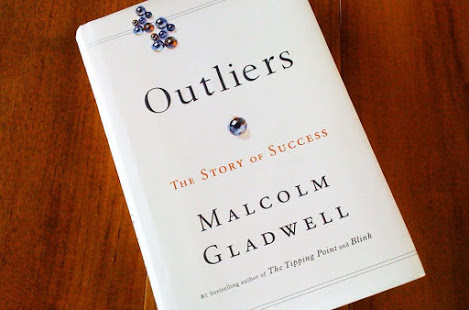
Outliers: The Story of Success by Malcolm Gladwell

OUTLIERS – THE STORY OF SUCCESS 
BY MALCOLM GLADWELL


Definition of outliers. An outlier is an observation that lies an abnormal distance from other values in a random sample from a population.

Malcolm Gladwell’s primary objective in Outliers is to examine achievement and failure as cultural phenomena in order to determine the factors that typically foster success.

Gladwell proposes that once a person has practiced his or her craft for 10,000 hours, they enter a threshold of genius through which fame and fortune become tangible possibilities. At that point, the person is talented enough or smart enough or capable enough to be truly successful.

The central thesis of the book is that while talent and dedicated practice are necessary for success, early advantage and privileged social standing are what truly make the outliers.

Outliers explains why “the self-made man” is a myth and what truly lies behind the success of the best people in their field, which is often a series of lucky events, rare opportunities and other external factors, which are out of our control.


THE 6 KEY POINTS IN THE BOOK 

1)   Opportunity knocks for some – often quite arbitrary (e.g. birthdates, in the right place etc)

2)   Timing – Critical to success and opportunity.

3)   Upbringing leads to opportunity – The quality of upbringing a child has been shown to be a key determinant on future success (even more so than pure IQ).

4)   10,000 hours – it typically takes that amount of time to ‘master’ something. People with opportunity have the chance to ‘do’ the 10,000 hours.  Others don’t.

5)   Meaningful work – If you feel there is real purpose to your work, it’s more likely you will work hard.

6)   Legacy – Our Values drive our behaviour. Our values are often passed down from generation to generation (e.g.  The Koreans are very deferential to  authority, which led to a series of plane crashes; Asians reliance on rice meant they learned the value of hard work and perseverance – which shows through in their better ability at maths (also their language helps).

Three lessons from the book.

Lesson 1: After you cross a certain skill threshold, your abilities won’t help you.  To debunk the myth of the “self-made man”, which might be the most popular myth of our time, Gladwell first looked at how much your skills really influence where you end up in life. Of course practice matters, and so do genetic predispositions in sports, but there are limits to their influence. As it turns out, once you cross a certain threshold with your skills and abilities, any extra won’t do you much good.

Lesson 2: Being born in the wrong month can put you at a disadvantage.  That’s because relative age matters, especially when you’re young. How old you are compared to your peers can give you a huge advantage or disadvantage, for example in sports.

Gladwell found out that most professional Canadian hockey players, who end up in the NHL, are born in the first half of the year. That’s because the annual cutoff date for youth teams is January 1st, meaning kids born in December have to compete with their friends who are almost a year older than they are. When you’re 8 years old, you stand no chance against a 9 year old in terms of strength and speed – the difference is huge when a year makes up 12.5% of your entire life.

Lesson 3: Asians are good at math, because where you come from matters.

Gladwell says there’s a reason for the stereotype that “Asians are good at math.” Several factors actually are in favor of Asians becoming relatively good at it. First, Asian languages are set up so that children learn to add numbers simultaneously with learning to count. Second, hundreds of years of building a traditional culture around farming rice has instilled a great sense of discipline into Asian culture. You have to stick with problems and let the gears in your brain crunch until you work it out. Europeans often give up a lot faster on hard math questions than their Asian peers, because neither math nor discipline are a part of their cultural legacy.


The 21 Absolutely Unbreakable Laws of Money by Brian Tracy

THE 21 ABSOLUTELY UNBREAKABLE LAWS OF MONEY BY BRIAN TRACY

Brian Tracy is Chairman and CEO of Brian Tracy International, a company specializing in the training and development of individuals and organizations.

He has consulted for more than 1,000 companies and addressed more than 5,000,000 people in 5,000 talks and seminars throughout the US, Canada and 55 other countries worldwide. As a Keynote speaker and seminar leader, he addresses more than 250,000 people each year.

Brian has studied, researched, written and spoken for 30 years in the fields of economics, history, business, philosophy and psychology. He is the top selling author of over 45 books that have been translated into dozens of languages.

One of your major goals in life should be financial independence. You  must aim to reach the point where you have enough money so that you never have to worry about money again. The good news is that financial independence is easier to achieve today than it has ever been before. We live in the richest country at the richest time in all of human history. We are surrounded by more wealth and affluence than ever before. Your goal should be to participate fully in what many people are starting to refer to as the “Golden Age”of mankind.  

Money has energy of its own and it is largely attracted to people who treat it well. Money tends to flow toward those people who can use it in the most productive ways to produce valuable goods and services, and who can invest it to create employment and opportunities that benefit others. At the same time, money flows away from those who use it poorly, or who spend it in non-productive ways. Your job is to acquire as much money as you honestly can and then to use it enhance the quality of your life and the lives of those you care about.

Here now are the Twenty-one Absolutely Unbreakable Laws 0f Money:

1. 1. The Law of Cause and Effect: Everything happens for a reason; there is a cause for every effect.

   2.  The Law of Belief: Whatever you truly believe, with feeling, becomes your reality.  

T   3.  The Law of Expectations: Whatever you expect, with confidence, becomes your own self-fulfilling prophecy.  


4. The Law of Attraction: You are a living magnet; you invariably attract into your life the people, situations and circumstances that are in harmony with your dominant thoughts.  


5.    The Law of Correspondence: Your outer world is a reflection of your inner world and corresponds with your dominant patterns of thinking.  


6.    The Law of Abundance: We live in an abundant universe in which there is sufficient money for all who really want it and are willing obey the laws governing its acquisition.  


7.    The Law of Exchange: Money is the medium through which people exchange their labor in the production of goods and services for the goods and services of others.  


8.   The Law of Capital: Your most valuable asset, in terms of cash flow, Discover how to build a successful business from scratch. Get full access to underground business development strategies, guerrilla marketing strategies, entrepreneurial skill development tips and insider’s startups advice.  


 9.  The Law of Time Perspective: The most successful people in any society are those who take the longest time period into consideration when making their day-to-day decisions.  


10.  The Law of Saving: Financial freedom comes to the person who saves ten percent or more of his income throughout his lifetime.  

1111.  The Law of Conservation:  Its not how much you make, but how much you keep, that determines your financial. 

   12. Parkinson’s Law: Expenses rise to meet income.  

1 13. The Law of Three: There are three legs to the stool of financial freedom: savings, insurance and investment.  

1 14. The Law of Investing: Investigate before you invest.  

1 15. The Law of Compound Interest: Investing your money carefully and allowing it to grow at compound interest will eventually make you rich.  

 16.  The Law of Accumulation:  Every great financial achievement is an accumulation of hundreds of small efforts and sacrifices that no one ever sees or appreciates.  

1 17.  The Law of Magnetism: The more money you save and accumulate, the more money you attract into your life. 

1 18. The Law of Accelerating Acceleration: The faster you move toward financial freedom, the faster it moves toward you.  

1 19. The Law of the Stock Market: The value of a stock is the total anticipated cash flow from the stock discounted to the present day.  

2 20. The Law of Real Estate: The value of a piece of Real Estate is the future earning power of that particular piece of property.  

2  21. The Law of the Internet:  The Internet is a tool for rapid communication of information of all kinds.

When you practice these powerful laws and principles in your own life, your financial future will be guaranteed. Learn how to earn more, save more, invest better, get out of debt, and become financially independent. Each strategy has been tested and proven to work. Listen, learn, and implement these ideas – starting today!


Cl       Click here to read the book



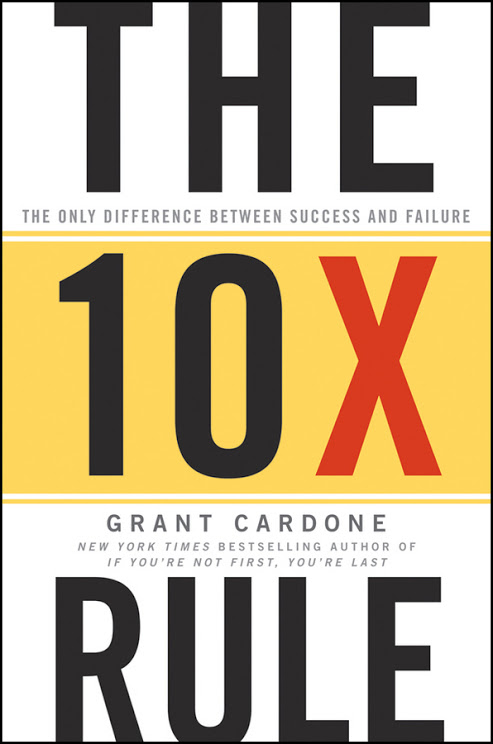
The 10X Rule: The Only Difference Between Success and Failure by Grant Cardone

THE 10 X RULE : THE ONLY DIFFERENCE BETWEEN SUCCESS AND FAILURE BY GRAND CARDONE

Grant Cardone is a New York Times bestselling author, international sales expert, sales trainer, and motivational speaker. He has created three multimillion-dollar companies, including Cardone Training Technologies, Cardone Group, and Twin Capital Management.

The 10X Rule says that :-

  • You should set targets for yourself that are 10X greater than what you believe you can achieve and 

  • You should take actions that are 10X greater than what you believe are necessary to achieve your goals. The biggest mistake most people make in life is not setting goals high enough.

The 10X Rule has two parts: outstanding effort and audacious goals. Most people know only three degrees of taking action, but there is a fourth one and it’s the best.

Four Degrees of Action

Most people fail only because they are operating at the wrong degree of action.

There are four choices or say degree of action:

  1. Do nothing
  2. Retreat
  3. Take normal levels of action
  4. Take massive action.

   The First Degree of Action

“Doing nothing” is exactly what it sounds like: no longer taking actions to move forward in order to learn, achieve, or control some area.

  The Second Degree of Action

“Retreaters” are those who take actions in reverse—probably in order to avoid negative experiences that they imagine will come as a result of taking action.

  The Third Degree of Action

People who take normal levels of action are probably the most prevalent in our society today. This is the group that appears on the surface to be taking the necessary amounts of action and to be “normal.”

  The Fourth Degree: Massive Action

Massive action is actually the level of action that creates new problems—and until you create problems, you’re not truly operating at the fourth stage of action

When you are taking massive action, you aren’t thinking in terms of how many hours you work. When you start operating at the fourth degree of action, your mindset will shift and so will your results.

The 10X rule assumes that the goal is never the problem. The problem is thinking and action. Any goal attacked with the right amount of thinking and action is attainable.

Achieve “Massive Action” results and accomplish your business dreams!

While most people operate with only three degrees of action-no action, retreat, or normal action-if you’re after big goals, you don’t want to settle for the ordinary. To reach the next level, you must understand the coveted 4th degree of action. This 4th degree, also know as the 10 X Rule, is that level of action that guarantees companies and individuals realize their goals and dreams.

The 10 X Rule unveils the principle of “Massive Action,” allowing you to blast through business cliches and risk-aversion while taking concrete steps to reach your dreams. It also demonstrates why people get stuck in the first three actions and how to move into making the 10X Rule a discipline. Find out exactly where to start, what to do, and how to follow up each action you take with more action to achieve Massive Action results.

  • Learn the “Estimation of Effort” calculation to ensure you exceed your targets
  • Make the Fourth Degree a way of life and defy mediocrity
  • Discover the time management myth
  • Get the exact reasons why people fail and others succeed
  • Know the exact formula to solve problems

Extreme success is by definition outside the realm of normal action. Instead of behaving like everybody else and settling for average results, take Massive Action with The 10 X Rule, remove luck and chance from your business equation, and lock in massive success.


Click here to read the book 

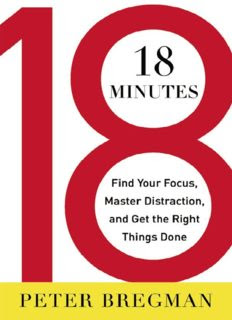
18 Minutes_ Find Your Focus, Master Distraction, and Get the Right Things Done by Peter Bregman

18 MINUTES – FIND YOUR FOCUS, MASTER DISTRACTION AND GET THE RIGHT THINGS DONE 
BY PETER BREGMAN

Do you sometimes find it difficult to concentrate? You’re not alone. With Facebook, Instagram and smartphones always with us, constantly beeping and buzzing, craving our attention, getting things done is tougher than ever.

So how do you fight these distractions and find your focus again? First of all, you need to accept that you can’t do everything. Then you need to make sure that the goals you have are really yours. Then it’s time to get going. Luckily, there are some neat tips and tricks that will make it easier for you to succeed. And it doesn’t require a lot of time either. Just 18 minutes.

Based upon his weekly Harvard Business Review columns (which is one of the most popular columns on HBR.com, receiving hundreds of thousands of unique page views a month), 18 Minutes clearly shows how busy people can cut through all the daily clutter and distractions and find a way to focus on those key items which are truly the top priorities in our lives.


Bregman works from the premise that the best way to combat constant and distracting interruptions is to create productive distractions of one’s own. Based upon a series of short bite-sized chapters, his approach allows us to safely navigate through the constant chatter of emails, text messages, phone calls, and endless meetings that prevent us from focusing our time on those things that are truly important to us.


Mixing first-person insights along with unique case studies, Bregman sprinkles his charming book with pathways which help guide us –pathways that can get us on the right trail in 18 minutes or less.


In 18 Minutes, Peter Bregman breaks down the keys to finding our focus, mastering distraction, and getting the right things done. Beginning with a mental and emotional reset and reevaluation of our priorities and passions, he guides us on a journey to a more rewarding and fulfilling use of our time.

Key Ideas

  •    Start by pausing and focusing on the best course of actionPausing allows you to think differently. If you don’t pause, you’ll be on autopilot and only act according to your previous ideas of how things are supposed to be. This leads to mistakes and missed opportunities. Pausing gives your mind time to calm down so that it can see things as they really are and recognize the possibilities for productivity.


  •   Find what’s right for you by leveraging your strengths and embracing your weaknesses. To be successful, you need to set goals and focus on your strengths. By not getting bogged down with gray areas or unproductive arguments about what is right or wrong, you can move things forward and excel at your job.


  • Assert your differences and pursue your passion while avoiding pitfallsIt is important to be successful, but it’s also important not to give up after a failure. If you do that, you’ll never learn from your mistakes and improve yourself.


  • Plan your day with the wisdom of the 18 minutes ritual.  First, spend five minutes in the morning going over your plans for the day. Include things that are important as well as those to avoid.Schedule time during each hour throughout the day for a minute long break so you can relax and refocus yourself before getting back at work again with renewed energy. The last step is to reflect on the day, taking five minutes at the end of each day. 


  • To prevent distractions, master your initiative, your boundaries and yourself. Setting boundaries is important for a distraction-free work zone. If you’re working from an office, make it clear to everyone that your privacy should be respected.


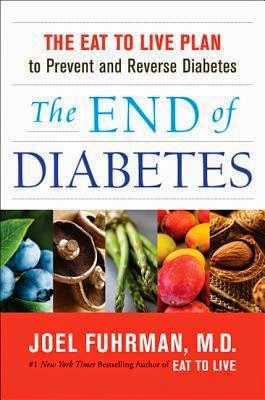
The End of Diabetes: The Eat to Live Plan to Prevent and Reverse Diabetes (Eat for Life) by Dr Joel Fuhrman

THE END OF DIABETES : THE EAT TO LIVE PLAN TO PREVENT AND REVERSE DIABETES(EAT FOR LIFE)
 BY DR JOEL FUHRMAN

The New York Times bestselling author of Eat to Live and Super Immunity and one of the leading experts on preventive medicine offers a scientifically proven, practical program to prevent and reverse diabetes—without drugs.

A breakthrough program to combat the rising diabetes epidemic and help millions of diabetics, as well as those suffering with high blood pressure and heart disease. Joel Fuhrman, M.D. Research director of the Nutritional Research Foundation, shows you how to live a long, healthy, and happy life—disease free. He offers a complete health transformation, starting with a diet with a high nutrient-per-calorie ratio that can be adapted for individual needs.

Dr. Fuhrman makes clear that we don’t have to “control” diabetes. Patients can choose to follow better nutritional guidelines that will control it for them, even before they have lost excess weight. The end result is a medical breakthrough—a comprehensive reversal of the disease.


Armed with a nutritional plan devised and tested over 20 years (on more than 10,000 patients), Dr. Fuhrman outlines a simple plant-based diet for diabetes that can put anyone back in shape. All you need to do is follow one easy formula:

Your Health Future (H) = Nutrients (N) / Calories (C)

This formula, Fuhrman explains, means your health is determined by the nutrient-per-calorie density of your diet. When you eat more foods that have a high-nutrient density (green vegetables, berries, beans, mushrooms, onions, seeds) and fewer foods with a low-nutrient density, your health will drastically improve and your diabetes will slow down. He strongly believes that the body is designed for wellness and when you give your body the necessary tools (in the form of nutrients), it will heal itself.

Eat Better. Curb Diabetes. That’s the true essence of The End of Diabetes and Dr. Fuhrman successfully manages to put that across in the most engaging way possible. With meal plans and recipes, backed by solid science, this page-turner shows you how you can take charge of your health by just eating better. The book also goes into great detail about how the standard diet causes diabetes, how the disease evolves, and how traditional medical treatments affect the course of the condition.

To sum the book up, The End of Diabetes is designed not just for diabetics, but for anyone who wishes to lead a disease-free life. What makes The End of Diabetes so convincing is not the fact that Fuhrman is an esteemed doctor who’s a specialist in the field. It’s that all his advice is derived from his patients’ remarkable stories and medical histories. The nutritarian diet he prescribes has helped thousands shed their weight and lead a fulfilling life. Any diet with such a high success rate is surely worth a shot.

The crux of the book is this: Type II diabetes can be prevented and reversed with a nutrient dense diet of plant based foods.

Click here to read the book

168 Hours: You Have More Time Than You Think

168 HOURS – YOU HAVE MORE TIME THAN YOU THINK 
BY LAURA VANDERKAM

It’s an unquestioned truth of modern life: we are starved for time. 

168 hours by  Laura Vanderkam168 Hours starts out with a discussion of the common modern narrative about how nobody has enough time. She strongly disagrees with this, arguing that 168 hours a week is enough time to fit in a robust career, a strong family life, exercise, hobbies, and enough sleep per night.

We tell ourselves we’d like to read more, get to the gym regularly, try new hobbies, and accomplish all kinds of goals. But then we give up because there just aren’t enough hours to do it all. 

Or if we don’t make excuses, we make sacrifices- taking time out from other things in order to fit it all in. 

There has to be a better way…and Laura Vanderkam has found one. After interviewing dozens of successful, happy people, she realized that they allocate their time differently than most of us.

 Instead of letting the daily grind crowd out the important stuff, they start by making sure there’s time for the important stuff. When plans go wrong and they run out of time, only their lesser priorities suffer. 

In her book Laura Vanderkam describes these steps which might help you analyze how you use your time and find the ways to optimize it:

  1. Log your time
  2. Make a list of your dreams
  3. Know your core competencies
  4. Minimize, outsource and ignore
  5. Fill small windows of time with bliss
Vanderkam shows that with a little examination and prioritizing, you’ll find it is possible to sleep eight hours a night, exercise five days a week, take piano lessons, and write a novel without giving up quality time for work, family, and other things that really matter.


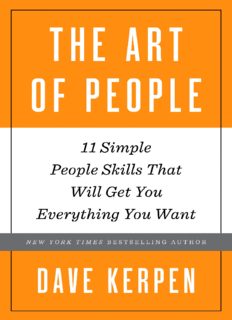
The Art of People_ 11 Simple People Skills That Will Get You Everything You Want by Dave Kerpen

THE ART OF PEOPLE – 11 SIMPLE PEOPLE SKILLS THAT WILL GIVE YOU EVERYTHING YOU WANT 
BY DAVE KERPEN

The Art of People is a guide written by Dave Kerpen on how to manage some of the most important people and relationships in your life. Kerpen emphasises that people matter. They matter more than anything, in managing your job, career, life, and relationship.

In a world where we are constantly connected, it’s those with the best people skills who win the day. Those who build the right relationships. Those who truly understand and connect with their colleagues, their customers, their partners. Those who others like, respect and trust.

The Art of People reveals the eleven people skills that will get you more of what you want at work, at home and in life. Accessible, easy to execute and often counter-intuitive, these include:

The single most important question you can ever ask to win attention in a meeting

– Why it usually pays to be the one to give the bad news
– How to get everyone to want to be around you, with one word

No matter who you are or what profession you’re in, The Art of People will show you how to charm and win over anyone.


Dave also talks about the art of persistence. As he describes it, “persistence is trying until you drop.” In 2001, Dave was a sales rep for Radio Disney. He was trying to reach a potential client by phone, (back then this was they main vehicle for connecting). Dave called and called and called some more – ultimately leaving 36 messages – when on the 37th call, she finally answered the phone. That call led to a sale and a $10,000 commission and taught him about persistence.

The 11 Skills To Master The Art Of People

  • Understanding yourself
  • Understanding people  
  • Meeting the right people
  • Connecting with people
  • Influencing people
  • Changing people’s minds
  • Teaching people
  • Leading people
  • Resolving conflict with people
  • Inspiring people
  • Keeping people happy
The conclusion is also interesting and really sums up the book; that behind every man is a great woman. In this case, it’s Dave’s wife Carrie who provides the ultimate wisdom with a paradox. As Carrie notes, “The secret to getting everything you want is not trying to get everything you want. Meet the right people, listen well, connect and inspire them and they’ll want to give you everything that you want.”


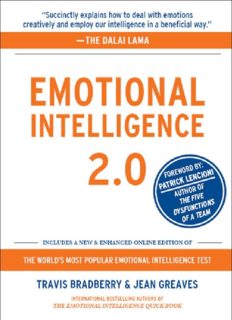
Emotional Intelligence 2.0 by Travis Bradberry and Jean Greaves

EMOTIONAL INTELLIGENCE 2.0 BY TRAVIS BRADBERRY AND JEAN GREAVES


Emotional Intelligence 2.0 is the actionable, practical version of Daniel Goleman’s brilliant book, Emotional Intelligence. Travis Bradberry and Jean Greaves created 2.0 with one central focus: to increase the reader’s emotional intelligence. The book is organized around the four elements of personal and social competence. Therein lies 66 practical strategies to improve competence in four areas: self-awareness, self-management, social awareness, and relationship management.

This book provides the reader with a code to take an emotional intelligence appraisal through Talent Smart. Talent Smart scores each area of competence from 1-99 and provides actionable strategies with a lower score. The test is meant to be taken before you read the book and should be re-evaluated after reading. Once again, this book is a practical handbook focused on increasing your emotional intelligence, and as such, the reader ought to examine a handful of practical strategies to implement in daily living.

It is a tough world we are dealing with and the concept of emotional intelligence is nothing new to us. But in their book, Emotional Intelligence 2.0, authors Travis Bradberry and Jean Greaves present a step-by-step programme that will help readers use effectively their emotional intelligence and enjoy the fruits of consistent performance and ultimately succeed in achieving their goals.

The book highlights the four core emotional intelligence skills which are self-awareness, self-management, social awareness and relationship management. 

In order to exceed one’s goals one not only has to identify one’s EQ skills but must also learn to develop these skills into strengths. Keeping this purpose in mind, the authors have focussed on how these four core skills can be achieved and strengthened. 

They have offered strategies for self-awareness, self-management, social awareness and relationship management. The strategies are full of insights and are straightforward. A daily practice of these strategies will help people respond effectively to their emotions. They equip a person to overcome the daily obstacles and help bring about a positive change in life.

 Lastly, man is incomplete without relationships. and so the strategies for relationship management are sure to deepen the connections people already have and also help critical relationships work.


Click here to read the book

Click here to read Emotional Intelligence by Daniel Golman on Kindle

Best Chess Teacher

Offering courses for teaching chess from starter to intermediate level students, available online for all learners.

Best Books to Read and Listen

Best Books to Read and Listen

Best Books to Read and Listen

Best Books to Read and Listen

WordCamp Nagpur 2019

11th August – MIA Centre For Sports & Recreation

Prabhat's Blog - Travel, Cricket and Shipbuilding

Travel on shoestring budget, enjoy cricket

Discover WordPress

A daily selection of the best content published on WordPress, collected for you by humans who love to read.

The Daily Post

The Art and Craft of Blogging

WordPress.com News

The latest news on WordPress.com and the WordPress community.